arXiv Caps Submissions at Two Per Month as AI Papers Flood In
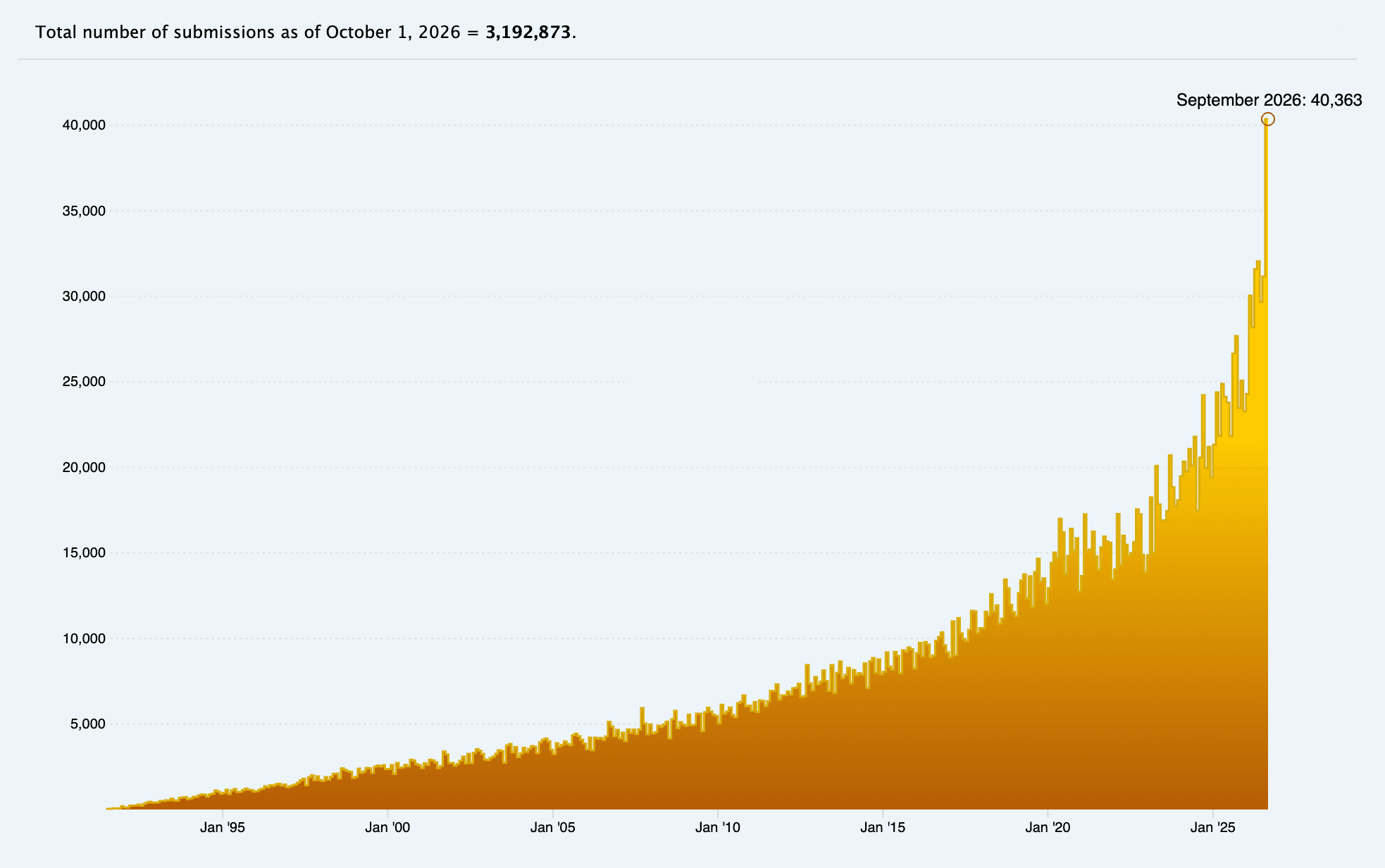
40,363 submissions in September, double what it was two years ago: science's most influential preprint repository is tightening the screws.
Who covers it
In brief
Since October 1, 2026, arXiv limits each submitter to two submissions per calendar month and three active submissions at once, across all categories. The measure, presented as temporary, responds to an explosion of thin papers, salami-sliced work, and AI-written text overwhelming volunteer moderators. It's one of the first concrete signs of a major scientific infrastructure adapting its rules to AI-assisted output.
🍺 Bar-stool version
arXiv is the giant mailbox where researchers dump their papers before publication, and it's overflowing: 40,000 submissions in a single month, twice as many as two years ago. The culprit isn't a sudden golden age of human genius, but AI tools that let you crank out a paper like filling in an expense report. So the rule drops: two papers per month max, rejections included, kind of like a restaurant capping the buffet because three customers kept walking out with Tupperware. When science has to ration the people writing, it means the bottleneck isn't writing anymore — it's reading.
Key takeaways
- 1
Since October 1, 2026, every arXiv submitter is limited to 2 submissions per calendar month and 3 active submissions max, across all categories.
- 2
arXiv received 40,363 submissions in September 2026, versus 20,569 in September 2024 and 9,869 in September 2016, generating nearly 9,000 support tickets.
- 3
The cs.AI category saw submissions multiply by more than 6x in two years; other categories doubled over the same period.
- 4
Moderators are seeing a rise in thin papers, 'salami' papers (one piece of work sliced into several articles), and dense AI-written text.
- 5
Rejected submissions count toward the quota, since it's the submission — not the publication — that consumes moderators' time.
- 6
The quota applies only to the submitter, not co-authors, and a paper withdrawn before announcement doesn't count.
- 7
arXiv frames the rule as a stopgap while it defines new best practices and improves its moderation tools.
Growth that became unmanageable
The numbers published by arXiv speak for themselves: 9,869 submissions in September 2016, 20,569 in September 2024, then 40,363 in September 2026. An all-time record since the repository's founding in 1991, and a doubling in just two years.
That volume carries a direct operational cost: nearly 9,000 support tickets generated in September alone. The phenomenon isn't unique to arXiv, which notes that open-access repositories overall are seeing submissions per author per month climb.
The cs.AI category bears the brunt of the shock, multiplying more than sixfold in two years. Other disciplines 'only' doubled.
The diagnosis: AI broke the practical limit
Before AI, arXiv explains, there was a practical limit easy to identify, tied to the pace at which a researcher could produce independent work. Volunteer moderators would flag, case by case, those who clearly exceeded it.
With more powerful and accessible AI tools, that limit has blurred. arXiv allows AI use as a research tool, provided it's disclosed and the work makes a real contribution to its field.
But many recent submissions fail that filter: thin papers with narrow scope, 'salami' papers slicing a single piece of work into multiple articles, and dense text visibly written by AI.
A question of fairness among authors
The core of arXiv's moderation relies on volunteers. Thomas Dietterich, chair of the Editorial Advisory Council, points to the problem: a small minority of authors submit a large number of low-quality papers and absorb a disproportionate share of moderators' time.
The concrete consequence: authors submitting serious work see their papers delayed by days, sometimes weeks. The new rule aims to fairly distribute this moderation time, which has become the scarce resource.
What the new rule precisely says
Two submissions per calendar month, three active submissions maximum at any time (this second limit has existed since 2024). The quota applies across all categories, and rejected papers count: submitting two rejected papers in one month means waiting until the next.
A few allowances: a paper still 'on hold' into the following month doesn't eat into that new month's quota, but still counts toward the three active ones. A paper withdrawn before its announcement doesn't count anywhere.
The limit applies to the submitter only. A team of co-authors can therefore split their submissions across multiple members, something arXiv explicitly invites them to coordinate. For conference deadlines or backlogs, the advice is simple: plan ahead.
A provisional measure, acknowledged as such
arXiv describes the policy as a stopgap, a holding solution while it figures out what best practices might look like for authors using increasingly advanced AI tools.
The repository promises to track the measure's effects on authors, readers, and the corpus, and to adjust it if needed. It also hopes for an incentive effect: pushing researchers to submit only their best work.
“With AI tools becoming more advanced and accessible to authors, the “practical limit” of how many papers can be submitted is now up for debate.”
“AI tools are making it easy for authors to flood arXiv and other repositories with these low-value papers.”
“A relatively small proportion of authors are submitting a large number of low-quality papers and consuming a disproportionate fraction of the moderators’ time. — Thomas Dietterich”
Why it matters
arXiv is the de facto infrastructure of AI research: it's where the papers that move the field come out, often well before any peer review. Seeing it impose a uniform quota is a significant admission: AI-assisted scientific output has shifted the bottleneck from writing to verification, and volunteers are footing the bill. The measure is defensible on fairness grounds, but it remains a blunt instrument. It also penalizes prolific, legitimate researchers, and those juggling conference deadlines. It's also easily gamed by simply splitting submissions among co-authors, something the FAQ almost admits between the lines. Above all, it addresses volume, not quality: a two-paper quota doesn't stop two mediocre AI-generated papers. The real work, which arXiv acknowledges by mentioning moderation tools to improve, will be detecting low value at scale without turning an open repository into a closed-off review process. Other open-access platforms facing the same wave will be watching the outcome closely.
Free account
You just read an AI Sources article
Create a free account: a month of archives in full, your own sources summed up like this one, your notes and highlights.
For you
Put it to work on your sources.
Free: a month of articles and three sources of your own. Pro: the whole archive and your sources, from €8/month.
For your team
The same machine, on your topics.
A space in your colours, your watch angles, your curators. Pilot open to three companies.