Claude Spots a Never-Before-Seen Enzyme System That Looks a Lot Like CRISPR
With its new biology lab, Anthropic shows 950 Claude agents uncovering in 21 hours a family of enzymes nobody had noticed before.
In brief
Anthropic is launching a life sciences research group with its own physical lab and publishing a first result: Claude agents, with minimal human supervision, identified an unknown enzyme system dubbed ART (array-associated reverse transcriptases). Its function is still unclear, but its structure recalls CRISPR and other programmable DNA-editing tools. It's a concrete demonstration of AI as a large-scale generator of scientific hypotheses.
🍺 Bar-stool version
Anthropic let loose 950 Claudes on a DNA database for a night and a half, kind of like sending an entire cohort of grad students to comb through a library, minus the coffee breaks and the burnout. One of them stumbled on a repeated motif next to a weird enzyme and basically shouted at the screen, which is roughly the enthusiasm level of a researcher who just saw a grant come through. Nobody knows yet what the thing actually does, but it closely resembles the family that gave us CRISPR, and CRISPR won a Nobel. If AI gets good at spotting what's off in nature, scientific discovery might be about to change pace.
Key takeaways
- 1
In spring 2026, Anthropic created a fundamental biology research group with its own lab in the Bay Area, limited to BSL-1 and BSL-2 biosafety levels.
- 2
About 950 Claude agents spent 21 hours and consumed 210 million tokens combing a massive DNA sequence database in search of reverse transcriptases (RTs).
- 3
The agents gathered over 200,000 RTs, isolated 3,500 candidate systems, then narrowed it down to the 20 most promising ones in readable reports, work that would take a human expert weeks to months.
- 4
The discovered system, ART, combines an RT, a partner gene of unknown function, and a long series of regularly spaced DNA repeats, an architecture reminiscent of CRISPR.
- 5
Early experiments show that this repeat array is expressed as distinct short RNAs, suggesting a potentially programmable mechanism.
- 6
Human involvement was limited to the initial prompt and the bench work; all lab manipulations were carried out by human scientists.
- 7
Feng Zhang, a pioneer of CRISPR genome editing (MIT, Broad Institute), called the discovery "genuinely intriguing" after reading the pre-print.
A biology lab inside an AI lab
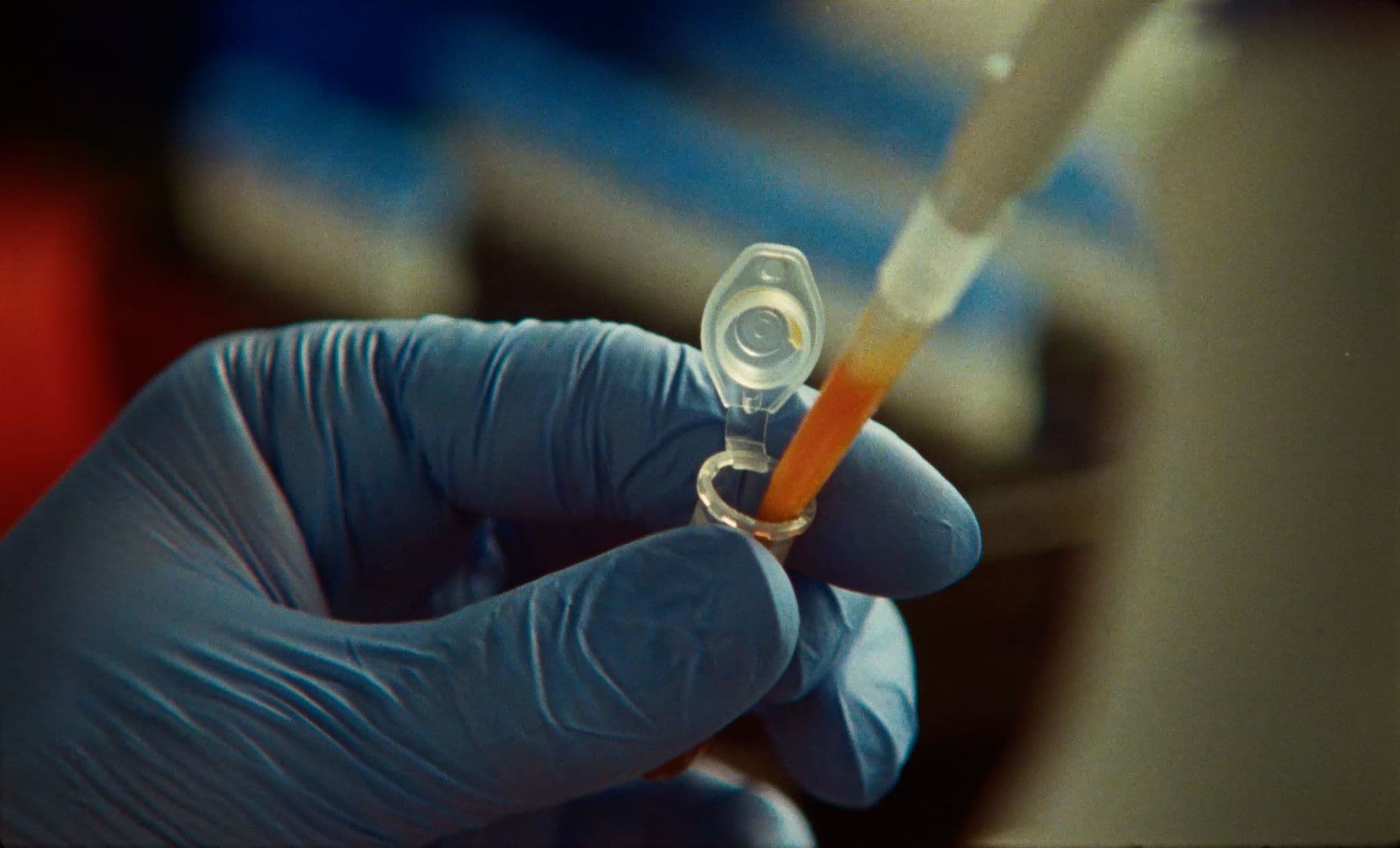
Anthropic announces the creation of a life sciences research group, with a physical lab set up in the Bay Area. The goal: do fundamental biology with Claude, exploring DNA datasets to identify uncharacterized protein families, generate hypotheses at scale, and test them at the bench.
The team consists of researchers specialized in computational DNA analysis, whose prior work covered CRISPR evolution and regulation or new enzymes for cell and gene therapies. It's integrated into Anthropic's life sciences organization, alongside teams focused on drug discovery and training Claude in biology and chemistry.
The lab remains deliberately modest in terms of risk: BSL-1 and BSL-2 only, no pathogens capable of infecting humans. And all manipulations are done by humans, since robotic automation doesn't mesh well with the improvised workflows of molecular biology.
The legacy of nature's "oddities"
Anthropic places its approach within a long lineage of discoveries born from an anomaly noticed in nature. Restriction enzymes, originating from bacterial immune systems, launched the biotech industry. Taq polymerase, found in a Yellowstone hot spring, became the basis for PCR.
CRISPR, finally, was first noticed as an unusual repeated sequence in the DNA of certain bacteria before becoming the foundation for gene-editing therapies. The question Anthropic is asking: can a general-purpose model systematize and speed up this kind of discovery?
How Claude found ART
The starting point is a simple prompt asking to search for interesting new examples of reverse transcriptases, enzymes that copy RNA into DNA. About 950 agents worked for 21 hours, scanning RT families and judging for themselves which candidates deserved attention.
One of them, while reading the raw sequence near an atypical RT found in a jumbo phage, spotted a tandem repeat array. It then proceeded like a researcher would: counting repeats, measuring spacing, comparing with known RT systems, doing a literature search, then submitting a report to humans.
The RT itself had already been identified in prior studies. What Claude appears to have been the first to note are the system's distinctive features: the associated array of non-coding sequences and an accessory protein of unknown function.
A still-mysterious but promising system
ART, found mostly in bacteriophages, brings together three elements: the RT, a partner gene, and a long series of regularly spaced repeats. This combination has only been observed in a handful of other systems, all of them programmable and capable of cutting, copying, or pasting DNA.
Early experiments show the array is transcribed into distinct short RNAs, similar to the guide RNA libraries that make CRISPR-Cas programmable. But ART's main function remains unknown, and Anthropic is choosing to publish early, via a pre-print, to showcase Claude's capabilities and open the topic up to the community.
Hypotheses become an object of study
The typical workflow: Claude reads the literature, reproduces established results to validate its methods, searches for proteins that don't match any described system, writes a report per candidate, then critiques its own evidence. Most leads get eliminated; a single campaign can end with just one candidate, or none at all.
Since Claude produces hundreds or thousands of reports per campaign, the team studies what distinguishes the proposals deemed worth testing. These lessons are fed back into the prompts to teach Claude to mimic researchers' "scientific taste." All of this runs inside Claude Science and Claude Code, sometimes with an in-house harness orchestrating parallel sessions.
“[The DNA next to the RT] is spectacular: I can see by eye a tandem repeat array … that's a CRISPR-like … repeat array?!”
“This is an exciting example of how AI agents can contribute to biological discovery. — Feng Zhang”
“Our involvement was limited to the initial prompt and the lab work.”
Why it matters
This is one of the most tangible demonstrations to date of an LLM that doesn't just assist a researcher but itself spots a previously unnoticed biological anomaly and documents it. The key figure isn't so much the 210 million tokens as the compression of time: genome-mining work that normally takes weeks to months, wrapped up in under a day. Still, it's worth staying level-headed. ART doesn't yet have a known function, the underlying RT was already catalogued, and the CRISPR analogy is for now a matter of structural resemblance, not proof of utility. The piece is also a corporate post that serves as a showcase for Claude Science and an expanded access program for life-science professionals. The most interesting stake lies elsewhere: if generating hypotheses becomes nearly free, the bottleneck shifts to sorting and experimental validation, and human "scientific taste" becomes the scarce resource that Anthropic is precisely trying to capture in its models.
For you
Put it to work on your sources.
Free: this week's articles and three sources of your own. Pro: the whole archive and your sources, from €8/month.
For your team
The same machine, on your topics.
A space in your colours, your watch angles, your curators. Pilot open to three companies.
Read next
 #claudeYesterday
Claude Opus 5.5: Stronger, 40% Cheaper to Run
Anthropic ships its first model since calling to "pace the frontier" — and puts efficiency at the center of the pitch.
Source · Anthropic · Introducing Claude Opus 5.5
 #anthropic19 Sept
Anthropic Opens Its Doors to Internal Evaluators Backed by $1 Billion
Accenture will place security auditors inside Anthropic, with access comparable to that of an employee — and billed to the lab itself.
Source · Anthropic · Partnering with Accenture on embedded evaluation
 #compute18 Sept
Anthropic Lifts the Hood: Claude "Leads" 26% of Its AI R&D
For the first time, a frontier lab has published numbers on how fast AI is building its own successor — and on what it's doing to keep watch over it.
Source · Anthropic · Measurements for understanding the pace of AI development inside frontier labs