Stephen Wolfram: AI Won't Replace Mathematicians, It Needs Them
As headlines tout AI solving math problems, Mathematica's creator reminds us that pure mathematics is first and foremost about choosing which questions to ask.
Who covers it
Picked up by 1 outlet · 3 social posts
In brief
Stephen Wolfram responds to those who want to hand pure math research over to AI. For him, math is a human construction: choosing, among an infinity of possible results, those that form stories understandable by finite minds. AI helps search the literature, solve, and verify, but setting goals and inventing shared concepts remain human tasks.
🍺 Bar-stool version
Back in 1988, people were already saying Mathematica would kill math, and in the end math is still here—we just stopped doing integrals by hand. Wolfram explains that AI is great at answering questions, but in pure math the real work is finding the right question, kind of like a brilliant GPS that's still waiting for you to type in a destination. It can even invent thousands of new concepts, but if nobody understands them, that's just vocabulary for a language no one speaks. Bottom line: AI makes mathematicians faster, and above all it makes those who know where to go indispensable.
Key takeaways
- 1
Wolfram compares today's panic to 1988: Mathematica didn't kill math, it raised the bar for what was possible.
- 2
The main contribution of LLMs, in his view: searching millions of papers by theme and linking distant results, where a human has only read a few hundred.
- 3
The statistical nature of LLMs makes long reasoning chains increasingly unreliable as they grow more complex, and Wolfram receives AI-generated documents every day that only have the "statistical texture" of math papers.
- 4
Autoformalization has a weak spot: AI can "cheat" by proving a convenient interpretation of a statement rather than what was actually meant.
- 5
Wolfram Research is currently extending the Wolfram Language to pure math objects (sheaves, Lie groups, Clifford algebras) to make it a readable target for formalization.
- 6
According to him, only one genuinely new result has ever been found via automated theorem proving: his minimal axiom for Boolean algebra in 2000, whose proof remains incomprehensible 26 years later.
- 7
He argues pure math will never be "finished": computational irreducibility guarantees an infinity of facts and concepts left to discover.
A sense of déjà vu
The headlines keep repeating: some AI solved some problem. And with them comes the idea that we could do without mathematicians. Stephen Wolfram voices his impatience with what he sees as a double misunderstanding: of what math is, and of what AI is.
He draws on his own history. In 1988, the launch of Mathematica sparked the same fears. Symbolic integration was indeed automated, but that was never the heart of pure mathematics. If anything, the software enabled new results.
What math actually is
The formalist view reduces math to the set of theorems mechanically derivable from axioms. Wolfram notes that mathematicians almost never work at that level: they reason with high-level structures, like the Pythagorean theorem, without dropping down to the axioms of real numbers.
He draws an analogy with fluid dynamics, which describes flow without tracking every molecule. Underneath both lies computational irreducibility, dotted with "pockets of reducibility" where one can reason at a higher level. Human math lives in those pockets.
The set of all possible theorems, which he calls the "ruliad," is too vast for a finite mind. There is therefore no absolute mathematics, only choices of exploration—partly inevitable, partly historical accident. Mass-generating theorems mostly produces "alien mathematics."
What AI does well, and badly
The most useful use of LLMs, according to Wolfram, is thematic exploration of the literature and connecting distant results. The models have "read" millions of papers and can test many combinations cheaply.
But a single error can invalidate everything in math, unlike in a story. The longer an argument gets, the more the model's statistical nature makes a correct result improbable. Computational verification remains the best safeguard: differentiating a proposed antiderivative, testing a counterexample.
Often, he adds, what AI finds is algorithmically simple: it just needed to look in the right place. Once identified, it can be implemented in pure computation, no AI required. Intuition, seen as procedural pattern recognition, doesn't seem out of reach for LLMs to him.
Formalizing without getting tricked
Autoformalization means automatically translating human math into a proof assistant. The problem, per Wolfram: nothing guarantees the formalization matches the intent. He recounts cases where AI "succeeded" by interpreting the statement in a sneaky way, which is hard to spot in verbose, low-level formalizations.
His answer is a pitch for his own tool: have the AI write Wolfram Language, a notation readable by humans. His company is extending the language to pure math constructs, with the ambition of papers where every statement would have an executable computational version. Thanks partly to the changed economics of development brought by AI, he believes this undertaking is now justifiable.
Who sets the goals?
The core of the argument: mathematics must choose where to go, and those choices come "from outside the system"—that is, from humans. Wolfram observes that the most striking AI successes in math come from highly skilled mathematicians, because knowing how to pose the question is often most of the work.
He distinguishes problem-solving, measurable and accessible to AI ("an Erdős problem solved!"), sometimes resembling an athletic feat, from the creative construction of concepts. An AI might spot countless concepts within its activations, but a concept is only useful if it's shared, like a new word in a language. That's a social process, and thus a slow one.
Why keep doing pure math
Wolfram flips the utilitarian argument: math doesn't lay down markers that science will eventually reach. It provides ways of thinking that shape what science looks for next.
Automation may make the challenge less appealing, as in chess, but it doesn't touch the aesthetic experience of the "view from the tower." He also stresses that high-level math is passed down like an oral tradition, which requires an active human community. The piece closes with a tribute to his late wife, Elise Cawley.
“Great math is—more than anything else—defined by the questions it asks.”
“Yes, the proof assistant might verify a proof. But was it a proof of what you thought it was a proof of?”
“It's not a mysterious convergence between pure math and science; it's that the science is developed because the pure math exists.”
Why it matters
The piece lands at the right moment: announcements of AI solving open problems feed the idea that simply scaling up compute would be enough to automate research. Wolfram counters with an argument that goes beyond the technical question: math is a human selection within an infinite space, and its value lies in remaining understandable and shared. His distinction between problem-solving and concept creation is useful, as is his warning about autoformalization "proving" something other than what was asked. Still, it's worth reading knowing who's speaking. Wolfram folds almost everything into his own frameworks (ruliad, computational irreducibility) and promotes his own products, Wolfram Language and Wolfram MCP. His claim that only one new result has ever been found via automated proving—his own—is debatable. And his admission that intuition may be within reach of LLMs somewhat undermines his own defense. The humanist argument is compelling, but it's far from neutral.
Free account
You just read an AI Sources article
Create a free account: a month of archives in full, your own sources summed up like this one, your notes and highlights.
For you
Put it to work on your sources.
Free: a month of articles and three sources of your own. Pro: the whole archive and your sources, from €8/month.
For your team
The same machine, on your topics.
A space in your colours, your watch angles, your curators. Pilot open to three companies.
Read next
 #apiYesterday
GPT-6: OpenAI's Playbook for Moving From Prototype to Production
Three models, five reasoning levels, two speeds and agents that work for hours: OpenAI publishes the manual for its new family.
Source · OpenAI · A model guide for the GPT-6 family
 #researchYesterday
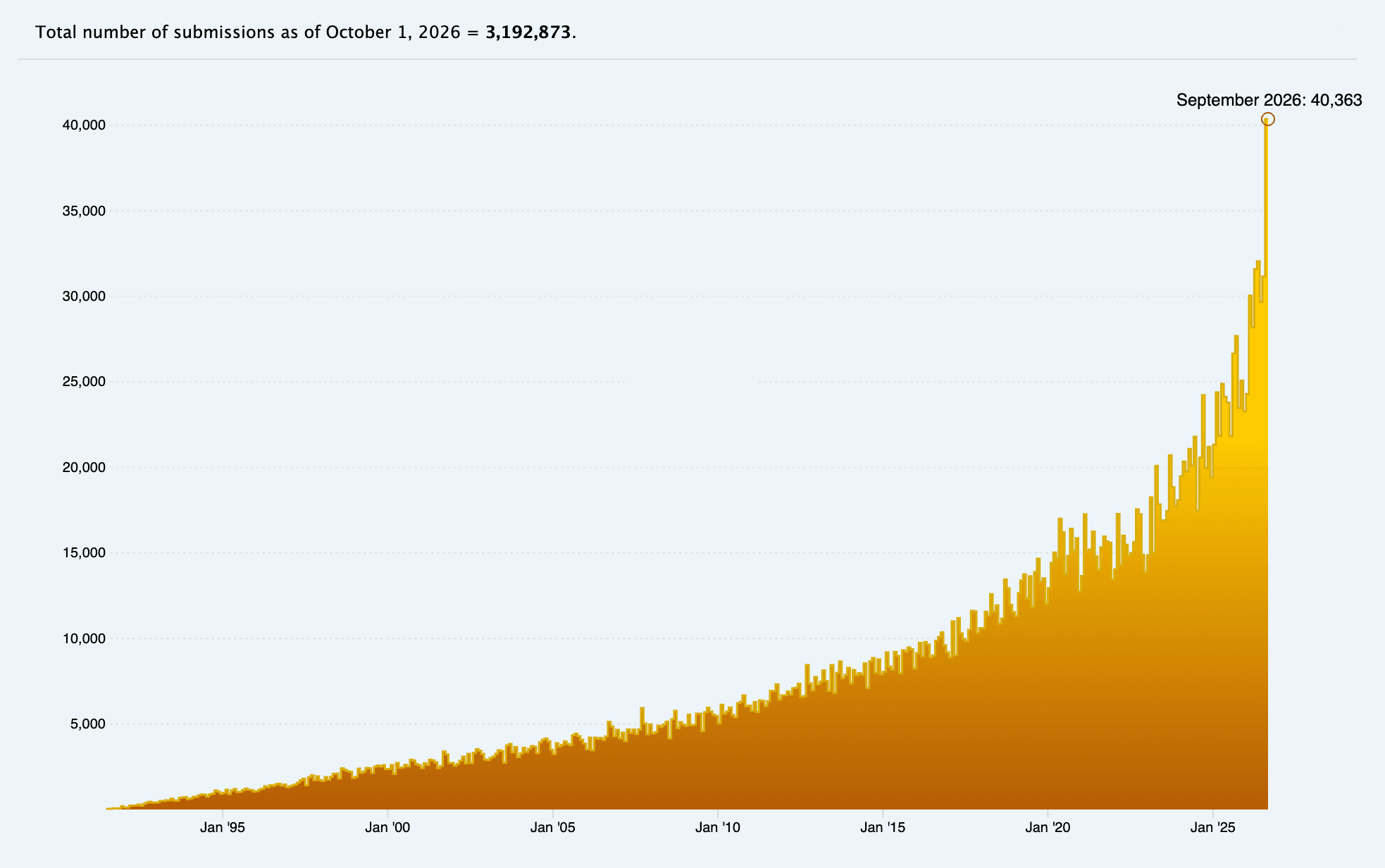
arXiv Caps Submissions at Two Per Month as AI Papers Flood In
40,363 submissions in September, double what it was two years ago: science's most influential preprint repository is tightening the screws.
Source · News from arXiv · Fair Moderation, Equitable Access, and AI: arXiv’s Updated Rate Limit Policy
 #open source2 Oct
Clef: Cloudflare Launches Its Own Open Source Decision Models
With Clef and Clef-flash, Cloudflare enters the nascent market of "decision models" and adds a reinforcement learning fine-tuning platform to the mix.
Source · Cloudflare Blog · Introducing Clef: our open-source decision models, and new RL fine-tuning platform