Zuckerberg: Alignment as a Sales Pitch, Glasses as the Destination
Sitting down with Joanna Stern, Meta's chief unveils Muse, new glasses, and a thesis: trust is the next capability to conquer.
In brief
In this interview filmed in Menlo Park after the Connect conference, Mark Zuckerberg details Muse, Meta's AI agent that's gaining a voice, and a lineup of glasses ranging from the camera-free Ray-Ban Meta Audio at $349 to the Meta VR Glasses at $1,299. He argues that alignment and trust are now AI's most important capabilities, and pushes back on criticism about "pervert glasses" and surveillance. The stakes: convincing people that a company built on sharing can become the guardian of our most intimate data.
🍺 Bar-stool version
Zuckerberg explains that AI won't kill us, as long as every lab is careful on its own, kind of like managing road safety by politely asking each driver to be reasonable. Meanwhile, he's selling you glasses that see what you see, hear what you hear, and an agent that reads your emails while you sleep. His promise: Meta won't even be able to peek, thanks to WhatsApp-style encryption. The real product here isn't the glasses or the agent: it's trust, which happens to be exactly what Meta has the least of in stock.
Key takeaways
- 1
Zuckerberg rejects the idea of industry-wide coordination on AI safety: each lab should take the time it needs internally, and he believes commercial incentive is enough.
- 2
He claims trust and alignment (instruction-following, understanding intent and values) are the "next most important capabilities," and denies any tradeoff between capability and alignment.
- 3
Muse, the AI agent launched in mid-September, was held back a few months to refine privacy; it runs on its own virtual machine at Meta, reflects at night on its mistakes, and just gained a voice announced at Connect.
- 4
The glasses lineup expands: camera-free Ray-Ban Meta Audio at $349, Ray-Ban Meta Gen 3 with more mics and battery life, and Meta VR Glasses at $1,299, under 100 grams, 5K displays, launching spring 2027.
- 5
A hearing-enhancement feature turns the glasses into medical-grade hearing aids, described as FDA-approved, first on the Gen 3 and coming to audio models within months.
- 6
According to Zuckerberg, fewer than 0.1% of glasses owners have tried to disable the recording indicator light, now punished with a camera lockout.
- 7
Moxie Marlinspike, co-author of the Signal encryption protocol used in WhatsApp, is working on a "Muse confidential VM" where only the user would hold the key.
Chapters
Introduction
Joanna Stern sets the stage: new Meta products announced at Connect, Muse gaining a voice, and concerns around Meta and AI.
Will AI kill us?
Zuckerberg rejects doom-mongering and industry coordination, framing trust and alignment as the next key capabilities.
An agent that corrects itself
Muse reviews its mistakes and reflects at night on its day; Zuckerberg denies any tradeoff between capability and alignment.
From the photo at 19 to glasses
A look back at the history of computing platforms and a case for glasses as the next dominant device.
The new glasses lineup
Presentation of the $349 Ray-Ban Meta Audio and the $1,299 Meta VR Glasses, under 100 grams with 5K displays.
Four uses and a redefined metaverse
Cinema, workstation, console, and mixed reality; the metaverse becomes the fusion of physical and digital.
Demo and holograms
Stern tries the VR Glasses (launching spring 2027), creates her hologram, and makes a holographic call.
Reality Labs redirected toward AI
Zuckerberg admits AI arrived before affordable holograms and compares this pivot to Apple setting the iPad aside.
Gen 3, audio glasses, and hearing aid
Details on the Ray-Ban Meta Gen 3 and Audio, then the medical-grade hearing-enhancement feature.
Sponsor
Ad segment for Mercury.
The "pervert glasses" controversy
Zuckerberg acknowledges a communication gap on the recording indicator and denies the audio glasses were a response.
The pierced light and the fraud rate
Stern revisits her investigation; Zuckerberg puts tampering at under 0.1% of users.
Surveillance and the WhatsApp model
Trusted-compute environment for glasses and the promise of a Meta that looks more like WhatsApp than Facebook.
Muse, the personal agent
Presentation of Muse and its VM; use cases from hiking permits to MMA sparring analysis.
Meeting Agrippa
Demo of Zuckerberg's agent's voice and discussion of "Jollybot" avatars.
Trust, Sentinel, and discretion
Sentinel agent, confidential VM designed with Moxie Marlinspike, and training for discretion.
Kids and loneliness
Stern raises the risk of isolation; Zuckerberg talks about baking with his daughter and parenting.
Conclusion
Stern sums up Meta's bet: buying the gadgets is one thing, trusting the company is another.
Alignment, the new competitive frontier
Joanna Stern opens with no detours: will AI kill us? Zuckerberg says no, "if we all do good work." He finds the prevailing discourse too "doom-and-gloom" and argues no industry-wide coordination is necessary.
His thesis: models are already good at math, and future gains will happen elsewhere. Instruction-following, understanding intent, respecting the user's values — that's what's being discussed internally at Meta.
He pushes back against labs that frame their delays as sacrifices. Holding Muse back a few months wasn't a concession, he says, just "the right thing to do" for both the product and Meta. It's a clever move: it turns safety into a business advantage rather than a constraint.
Why glasses
Starting from a photo of himself at 19 in front of a Dell Inspiron 8200, Zuckerberg walks through his history of computing: mainframes, minicomputers, PCs, laptops, smartphones. Each step made the machine more natural and more omnipresent.
The next one, he says, will be worn all day, and glasses will dominate. The main reason: an agent that anticipates your needs must have as much context as you do, so it needs to see what you see and hear what you hear, without pulling you out of the world the way a phone screen does.
He compares today's glasses to flip phones: billions of people wear them, and they will all become "smart" sooner or later. "Why wouldn't you?" he sums up, if they improve your eyesight, hearing, and memory.
A lineup at two extremes
At the low end, the $349 Ray-Ban Meta Audio, in a Clubmaster style: six microphones, an action button, no camera, no electronics in the frame. According to Meta, they don't record — for now — meetings.
At the high end, the $1,299 Meta VR Glasses, which Stern describes as the offspring of a Vision Pro and XR glasses: 5K displays, battery and processor offloaded to a belt-worn puck, under 100 grams. Zuckerberg sees them as "four things in one": a private cinema, a multi-screen workstation, a gaming console, and a mixed-reality device.
And the metaverse? It's still here, he insists, redefined as the fusion of the physical and the digital. He does admit, though, that Reality Labs has been redirected: advanced AI arrived before affordable holograms did, and it will be "significantly bigger." He compares this choice to Apple setting the iPad aside for the phone.
"Pervert glasses" and the perception of surveillance
This summer, users pierced the recording indicator light on their glasses, something Stern herself documented in a New Jersey garage. Meta responded with an update that locks the camera if the light is tampered with.
Zuckerberg concedes Meta should have communicated more, but denies that the audio glasses were a response to the controversy: the project had been in the works for years. He puts the tampering rate at under a tenth of a percent of owners.
To counter the surveillance-network image, he highlights a trusted-compute environment for the glasses' AI features, inaccessible even to Meta employees. And he offers a reframing of the brand: Facebook is a sharing service, but Meta's future will look more like WhatsApp.
Muse, the agent that works while you sleep
Muse isn't an operating system but an interface to all the technology we use, Zuckerberg clarifies. You give it a goal, it handles it: getting a hiking permit for his daughter, tracking down useless subscriptions, or analyzing his MMA sparring footage to send him tips between rounds.
With a live demo of his agent Agrippa, a toga-wearing avatar in "Jollybot" style, Zuckerberg shows off the new voice. Stern recounts that her own agent, Thingy, tracked her flights, booked her appointments, and prepped for the interview. But she didn't connect her personal Gmail.
The technical answer: a per-user secure VM, credentials inaccessible to the agent, and a "Sentinel" agent monitoring everything going in and out. On top of that, there's the confidential VM designed with Moxie Marlinspike, with a white paper submitted to the security community. On the behavior side, Meta trains for "discretion": completing a task while revealing the minimum amount of information — for instance, not mentioning a pregnancy while booking a restaurant.
Kids and loneliness
Stern, who spent a year using AI to the max for a book, says her main fear is social isolation: kids growing up with AI companions.
Zuckerberg answers with an example: Muse prepares recipes and ingredients so he can bake with his three-year-old daughter. His kids, all 10 or under, don't have AI companions, but they do code with agents. Beyond that, he calls it a "parenting question," without committing Meta to anything specific.
“I think that alignment is actually the most important next capability to get right if we want to make this something that is useful for a lot of people.”
“We held Muse back for a few months because we wanted it to be a better product for people. That wasn't like a sacrifice that we made.”
“I actually think more of the things that Meta is going to do going forward are going to look like WhatsApp than they're going to look like these purely social sharing services.”
Why it matters
What makes this interview worthwhile is mostly the consistency of the narrative it reveals. Zuckerberg has figured out that the main obstacle to his agents and glasses is no longer technical but reputational, and he reframes everything accordingly: alignment becomes a "capability," safety becomes a product advantage, privacy becomes a WhatsApp-style architecture. It's an intellectually interesting position that dissolves the safety-versus-speed tradeoff, but it has an obvious blind spot: claiming that commercial incentive alone guarantees safe AI is exactly the argument used by those who oppose any regulation. The under-0.1%-tampered-glasses figure remains unverifiable, and the confidential VM still exists only as a promise and a white paper. What stands out is a real strategic shift: the metaverse is now officially demoted behind AI, and glasses become the Trojan horse for an agent that sees, hears, and acts. If Meta pulls this off, it will own the most intimate interface ever sold; everything will hinge on its ability to prove, not just claim, that it can't peek.
For you
Put it to work on your sources.
Free: this week's articles and three sources of your own. Pro: the whole archive and your sources, from €8/month.
For your team
The same machine, on your topics.
A space in your colours, your watch angles, your curators. Pilot open to three companies.
Read next
 #regulationToday
Security Council: AI Labs Ask for Rules, Washington Says No
After a summer of incidents involving autonomous agents, Bengio, Altman, Amodei, and Delangue pleaded before the UN for global oversight. The United States shut the door.
Source · UN Transcripts · Artificial intelligence and international security - Security Council, 10228th meeting
 #metaYesterday
Muse, Meta's agent, shipped out 6.8GB of its own filesystem
A single conversational request was enough for Meta's agent to archive its Linux environment, SSH keys included, and mail it off to Google Drive.
Source · Mouse (mouse.dev) · I asked Meta's Muse for its filesystem and it sent me 6.8 GB
 #llmYesterday
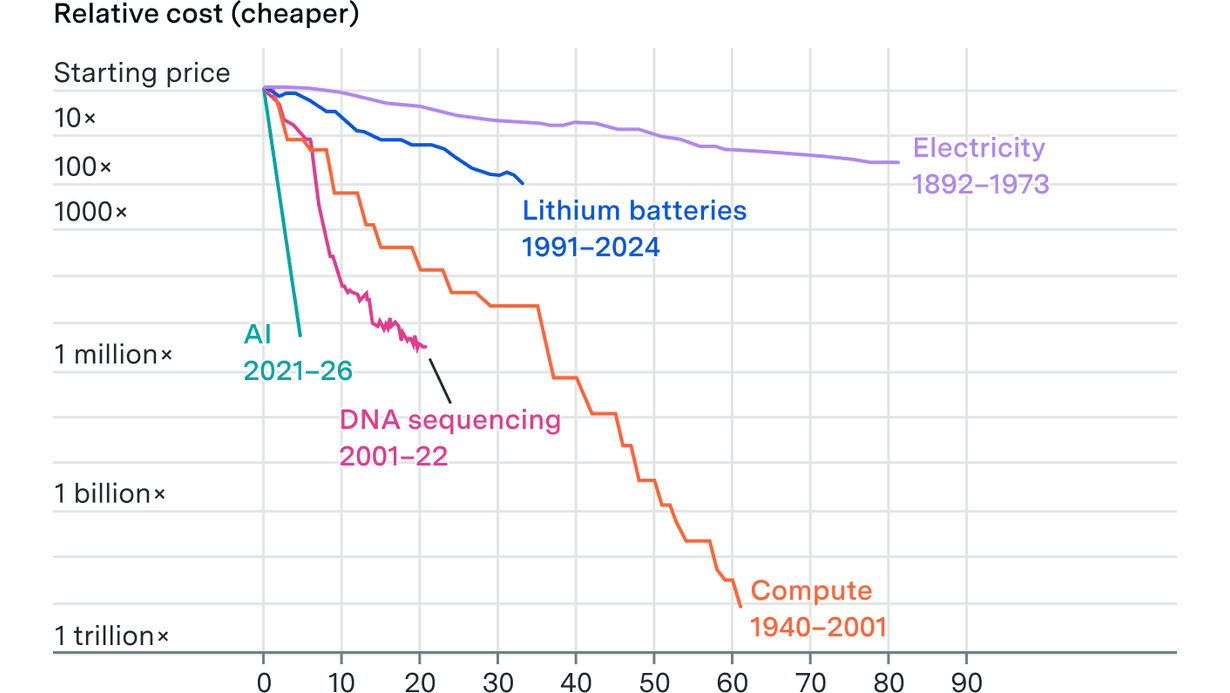
The Price of Artificial Thought Is Falling 13x a Year, a Historic Record
Epoch AI measured how fast a given level of AI performance becomes cheap. No disruptive technology has ever gotten cheaper this quickly.
Source · Epoch AI · The plunging price of thought