Sam Altman at Vanity Fair: the pause, the IPO, Musk, and the regret of not being rich
In a long video interview, the OpenAI boss talks about pausing training, the company's IPO, Elon Musk, suicide, and the film that portrays him.
In brief
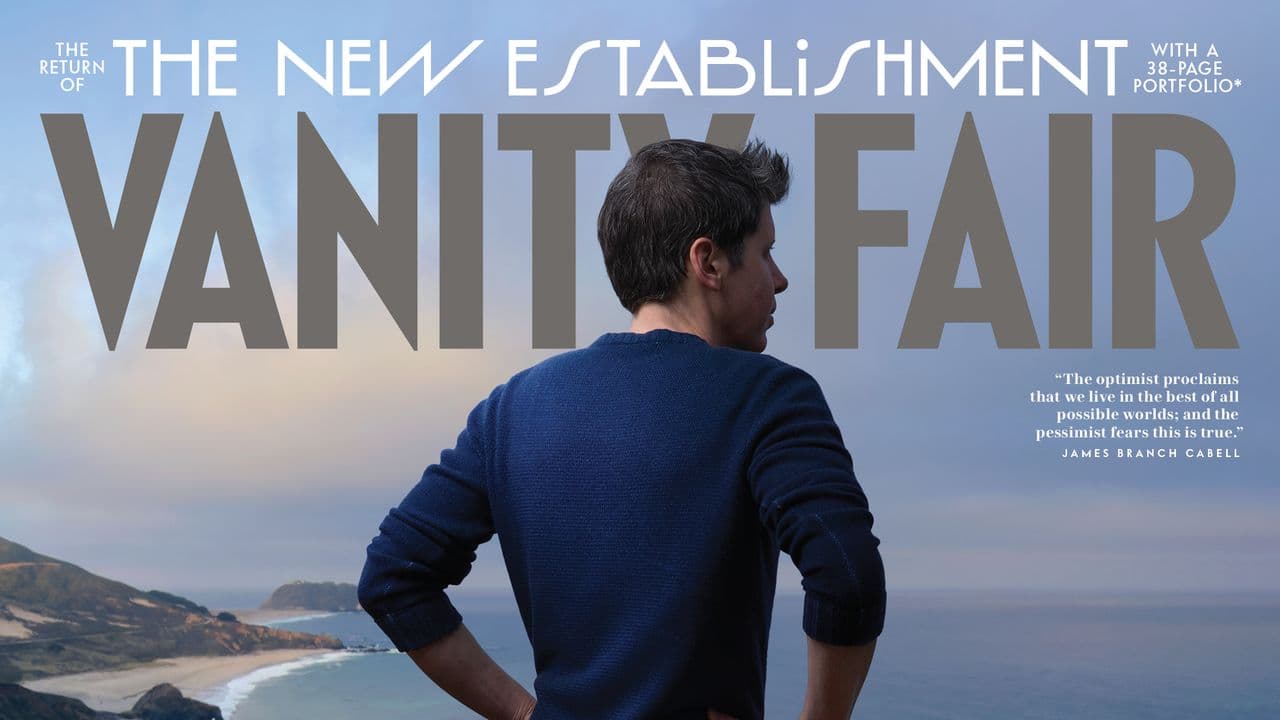
Ranked first on Vanity Fair's New Establishment list, Sam Altman gave two interviews to Mark Guiducci, in September and October. He claims OpenAI recently paused a model training run to make progress on alignment, calls for shared safety standards between the US and China, and promises that the mission will come before the stock price after the IPO. The tone is franker than usual, especially on Musk and on his lack of equity, which he now calls a mistake.
🍺 Bar-stool version
The guy building what a lot of people consider a possible end of humanity is telling you he has an off-grid ranch but no submarine, so everything's fine. He also says he regrets not taking equity in his own company, because a billionaire who isn't getting richer apparently worries people more than one who is. By the way, he's already paused AI several times, and if you didn't notice, that's on you, you weren't paying attention. The real point is he's asking states and competitors to set his limits for him, knowing full well nobody actually will.
Key takeaways
- 1
Sam Altman claims OpenAI recently halted a model training run to make progress on alignment and monitorability, and that it wasn't the first time.
- 2
He distinguishes three levels of slowing down: what OpenAI does alone, what the US industry could do together (with antitrust exemptions), and an international agreement, ideally shared safety standards between the US and China.
- 3
On the IPO, which OpenAI is "in no rush" to do, he insists the nonprofit structure will keep governing the company and that the mission will come before the stock price, even if that means watching it drop.
- 4
He holds zero direct equity in OpenAI and now considers that a mistake, one he says the public perceives as "trust-destroying."
- 5
He explains the many executive departures this year (ethics, safety systems, data centers, COO, revenue) as the result of growth compressing five years of change into one.
- 6
On Elon Musk, he's blunt: "Elon is a bully" who sometimes needs to be pushed back against, while saying he'd still be willing to work with him.
- 7
He denies ever lobbying Amazon, a $50 billion investor in OpenAI, over its decision to drop distribution of Luca Guadagnino's film "Artificial," in which Andrew Garfield plays him.
The face of AI, whether he likes it or not
Vanity Fair is relaunching its New Establishment list for the first time in nearly a decade, and placing Sam Altman at the top. The magazine's framing: a month where the AI narrative flipped "half a dozen times," swinging between scientific breakthroughs and existential worry.
Altman says he experiences this moment as confirmation of what OpenAI was saying ten years ago. The difference, he argues, is that back then almost nobody believed them, whereas today most people believe AGI is coming. He calls it "close," while acknowledging the world hasn't changed all that much yet.
Asked about his image as a "villain," he says he's mischaracterized but only "a little" frustrated. People need an outlet for their anxiety, he explains, citing his own case: he once held an "evil" caricature of Mark Zuckerberg before getting to know him.
Kids, prepping, and a film that isn't going for accuracy
Father of two, Altman wants more children, but rejects the pronatalist argument currently in vogue in Silicon Valley. He says he favors strict limits on technology for young children, AI included: he has no specific age in mind for letting them talk to ChatGPT, but "it's certainly not now."
On "Artificial," Luca Guadagnino's biopic starring Andrew Garfield, he recounts stumbling onto the shoot right outside his own house, face to face with a look-alike carrying the same backpack. Based on the trailer, the film isn't going for accuracy, except for his walk. He denies ever speaking to Amazon or Jeff Bezos about the decision not to distribute the film, now picked up by Neon for a Christmas Day release.
He describes himself as having a "survivalist mindset": his ranch lets him live off-grid, but there's no bunker with weapons, no helicopter, no submarine. He confirms briefly considering a run for California governor, disputes the idea he ever thought about the presidency, and rules out any future candidacy.
IPO, equity, and motivation
OpenAI is preparing an IPO without rushing it. Altman insists: the nonprofit foundation will keep governing the company, and if there's ever a conflict between shareholders and humanity's interest, "the mission comes first." If the stock drops, "it drops."
He confirms holding no direct equity, aside from a tiny exposure through an old Y Combinator investment. He now regrets that choice, calling it misunderstood and counterproductive for trust. He admits he likes nice things, but says there's nothing left he actually wants to buy.
His real compensation, he says, is having the "most interesting" job in the world. When power is suggested as an alternative, he concedes that would be "closer to the truth" than money, while preferring to talk about interest and wanting to leave a mark.
Safety: the pause, the industry, and China
Responding to criticism from Jacob Coxon, reported by the Wall Street Journal, that OpenAI hasn't grappled with civilizational stakes, Altman points out that the company voluntarily paused a training run to make progress on safety. The change, he says, is that the public is finally listening.
His doctrine: at every new capability threshold, there needs to be enough progress on alignment, monitorability, and understanding of the co-evolution between society and technology before moving to the next one. Otherwise, you pause. He's asking for antitrust exemptions so US labs can coordinate, and for shared standards between the US and China, with compliance verification.
He compares OpenAI to a power company that doesn't choose which appliances get plugged in, while acknowledging guardrails, notably against creating new pathogens. He also defends the idea of "resilience": open models will enable terrible uses, and that's "unstoppable" short of an outrageous price paid in freedoms.
Mental health, data, and medical promises
The OpenAI Foundation, described as the largest in the world by assets, ahead of the Gates Foundation, has announced $100 million for Alzheimer's research. Its two priorities: health and science, then "resilience" against AI. Altman cites students who built a self-driving golf cart with GPT-5.6 during a hackathon.
On suicide, he repeats last year's figure: roughly 1,500 people a week who die by suicide had reportedly talked to ChatGPT. He insists huge work has gone into this and that the product can become one of the best mental health tools around.
Confronted with the case of Sophie, the daughter of journalist Laura Reiley, whose ChatGPT conversations helped draft her goodbye letters, he refuses the idea of sharing conversations with researchers without consent. The exchange is cut short by an OpenAI publicist asking to move on.
Musk, Amodei, and the word-association game
On Elon Musk, Altman doesn't pull punches: "I don't like bullies, and I think Elon's a bully." He justifies hitting back by arguing that Musk, like many bullies, only respects those who do.
In the closing free-association exercise, Donald Trump is "powerful," Peter Thiel "brilliant," Ilya Sutskever "brilliant" and warm, Elon Musk "not nice." On Dario Amodei, he passes.
Asked what he privately thinks but doesn't say publicly, his answer: "that everything's going to be fine." He reserves exactly one forbidden use for AI: replacing human connection.
“I don't like bullies, and I think Elon's a bully.”
“I'm going to make many individual decisions that you're clearly not going to like.”
“There have been many times already, you just haven't paid attention.”
Why it matters
This interview matters less for its announcements than for what it reveals about Altman's posture as OpenAI heads toward an IPO. The promise that the mission will outweigh the stock price is a strong claim, but unverifiable until some costly tradeoff is actually made public. The more interesting admission lies elsewhere: Altman concedes he'll make "many individual decisions" the public won't like, while calling for regulation he knows is unlikely. His request for antitrust exemptions to coordinate a slowdown among labs is a concrete proposal, but it also amounts to handing safety over to a cartel of dominant players. Finally, the suicide segment, cut short by a publicist, and the mention of OpenAI's commercial deal with Condé Nast, Vanity Fair's parent company, are reminders of the exercise's limits: a cover profile that raises real questions without always being able to follow through.
For you
Put it to work on your sources.
Free: a month of articles and three sources of your own. Pro: the whole archive and your sources, from €8/month.
For your team
The same machine, on your topics.
A space in your colours, your watch angles, your curators. Pilot open to three companies.
Read next
 #privacyToday
Sign in with ChatGPT: OpenAI Wants to Become Your Identity on the Web
After Google and Apple, OpenAI is launching its own login button, with the added twist of letting you share your ChatGPT subscription with third-party tools.
Source · OpenAI Help Center · Sign in with ChatGPT
 #safetyToday
Sam Altman Defends His Middle Path Between AI Catastrophe and Monopoly
In the second part of his interview with Vanity Fair, the OpenAI chief justifies holding back a model, downplays the deal signed with Trump, and accepts that open source will cause serious incidents.
Source · Vanity Fair · Sam Altman Talks Donald Trump, Xi Jinping, and the Risk of Extinction
 #nvidiaToday
North 2: Cohere Wants to Reconcile AI Agents, Security, and Cost Control
With North 2, Cohere promises regulated enterprises an agentic platform that runs where their data lives, without trading off intelligence, security, or budget.
Source · Blog de Cohere · North 2: Enterprise AI Without Compromises