Leo XIV on AI: "I sleep at night," but Nvidia gets a scolding
On the flight back from France, the pope calls warnings about catastrophic AI risks serious and points out the contradiction in Nvidia's CEO stance on regulation.
In brief
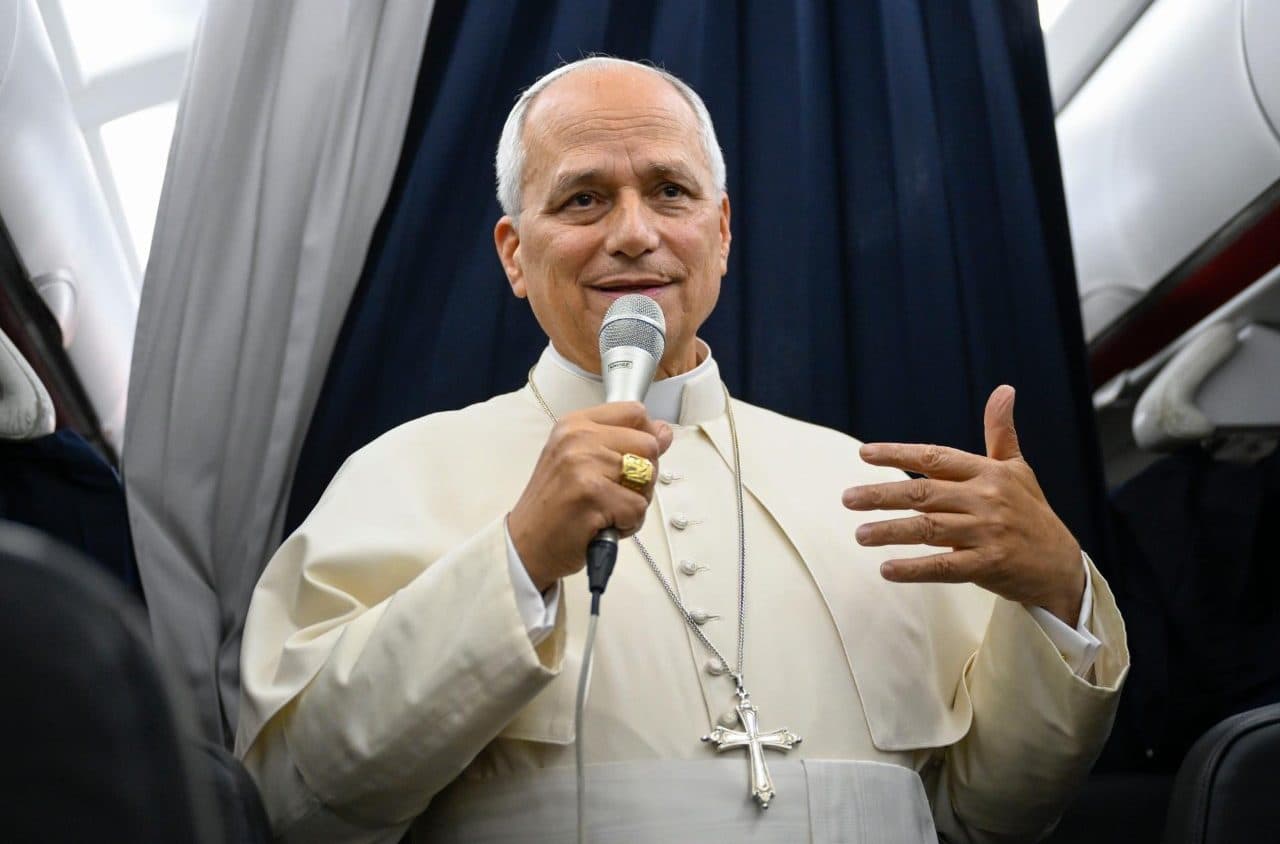
During the in-flight press conference between Metz and Rome, Leo XIV answered a question about existential AI risks: no panic, but experts' warnings should be taken seriously. He notes that Nvidia's CEO touts his own safeguards while refusing any regulation, and announces that the Vatican's AI commission has been broadening its dialogue since the publication of Magnifica Humanitas. The rest of the exchange covers the war in Ukraine, euthanasia, sexual abuse, housing, and Germany.
🍺 Bar-stool version
They asked the pope, on the plane, whether AI was going to destroy humanity, and his answer is pretty reassuring: he sleeps at night. Still, he pointed out that Nvidia's CEO claims to have invented safeguards for his AIs while demanding zero rules for himself — a bit like a carmaker pitching seatbelts while lobbying against traffic laws. So the Vatican set up its own commission on the topic, and when an institution that thinks in centuries finds things moving fast, maybe things really are moving fast. Bottom line: the planet's most listened-to moral voice officially filing AI risk under "serious" rather than "fake news" is what actually matters here.
Key takeaways
- 1
Asked by Justin McLellan (National Catholic Reporter) after cyberattacks attributed to "AI agents out of control," Leo XIV says he's not "in panic mode" but believes experts' warnings should be taken seriously.
- 2
The pope rejects the idea that these warnings are fake news serving financial interests.
- 3
He highlights a contradiction from Nvidia's CEO: the man says he's figured out how to build safeguards into AI, yet argues against any limits or public regulation.
- 4
The Vatican has an AI commission, originally created to coordinate internal use of AI at the Holy See, now being approached from all sides since the publication of Magnifica Humanitas.
- 5
Leo XIV says he's "relatively optimistic" about avoiding a scenario where AI destroys humanity or "excludes it from the conversation," while criticizing the power-driven race toward AGI.
- 6
On conflicts, he denounces a weapons industry that enriches a few while those billions could fund the fight against hunger, housing, or unemployment.
- 7
He calls on Russia and Ukraine to sit down and negotiate, and maintains he hasn't crossed the secularism line by opposing euthanasia, recently legalized in France.
A press conference at 10,000 meters
On the Monday evening ending his apostolic trip to France, Leo XIV answered questions from some 80 journalists on the Metz-Rome flight. Vatican News published a transcript and working English translation.
The pope opens with a recap of four days "filled with blessings": Lourdes, time with the sick, and a stadium gathering 80,000 young people from across France. Then come the questions, covering religious, social, and geopolitical news.
Among them, a direct question on artificial intelligence, following up on his Paris speech about the urgency of "ethical discernment" in the face of AI development.
AI's existential risk, without panic
Justin McLellan, from the National Catholic Reporter, cites cyberattacks carried out by out-of-control AI agents and warnings from tech leaders that the technology could destroy the world. He also asks what the United States and China should do.
The answer is nuanced: "If someone were to ask me, am I in panic mode? No, I'm not. I sleep at night." But Leo XIV insists that experts' concerns should be taken seriously, refusing to dismiss them as fake news serving financial interests.
He sums up his position in one line: simply saying "it won't happen" and closing one's eyes is "probably not the most responsible" way to approach the issue.
Nvidia, safeguards, and refusal to regulate
The most striking passage targets Nvidia's CEO. The pope says he read that same day that the CEO claims to have found a way to build safeguards into AI — limits preventing systems from stepping outside their bounds and causing the feared harms.
"He's the same one, however, that says there should be no limits placed and no government regulation," Leo XIV points out — a way of highlighting the gap between the technical self-regulation the industry claims and its rejection of any public framework.
His conclusion is methodological rather than prescriptive: bring together political leaders, AI leaders, social organizations, and associations to examine what's already happening and what could come next. He doesn't directly answer the specific question about Washington and Beijing's roles.
The Vatican's AI commission expands
The Holy See has created its own commission on artificial intelligence. It initially served to coordinate internal AI use at the Vatican and assess its risks and benefits.
Since the publication of Magnifica Humanitas — a text whose opening chapters on the Church's social doctrine the pope quotes — the commission has been receiving numerous requests from varied fields. Its stated goal: promote dialogue, studies, and research so that AI never reaches the point where it could destroy humanity or exclude it from the conversation.
Leo XIV calls himself "relatively optimistic," believing enough actors are willing to move past questions of power, of "who gets there first," and what will happen with artificial general intelligence.
War, euthanasia, abuse, housing, Germany
On Ukraine, the pope denounces rearmament and a military industry that enriches "a small number of people," when those billions could instead fight hunger, poor housing, or unemployment. He calls on Russia and Ukraine to talk, recalling his envoys, Archbishop Gallagher and then Cardinal Zuppi.
On euthanasia legalized in France, he believes he hasn't crossed the secularism line: defending life is applying the Gospel, not doing politics. On sexual abuse, he prefers not to speak of a "systemic" character in general terms, while acknowledging that some Church organizations have operated abusively "like a system."
Asked about the case of Mari Carmen, 87, evicted in Madrid after her rent was multiplied fivefold, he calls on authorities to address the systemic causes of the housing crisis. Finally, he has no date yet for Germany, with the only confirmed trip next year being World Youth Day in Korea, and expresses concern over the rise of a far right mixed with a religiosity he considers inauthentic.
“If someone were to ask me, am I in panic mode? No, I'm not. I sleep at night.”
“He's the same one, however, that says there should be no limits placed and no government regulation.”
“We have to keep working, we can't sit back and pretend nothing is going to happen.”
Why it matters
This answer matters less for its technical content than for the position it establishes. Leo XIV, who has made AI a pillar of his papacy, refuses both dominant postures: catastrophism and denial. By calling experts' warnings serious rather than commercial maneuvering, he legitimizes the debate over extreme risks for an audience that reads neither alignment papers nor Silicon Valley forums. His jab at Nvidia's CEO is more political than it appears: it strikes at the heart of the industry's argument that safety can be technically guaranteed from within, without external constraints. One might regret that the pope dodges the specific question about the US and China, and that the Vatican commission remains vague about its resources and deliverables. But in a landscape where regulation is retreating, a globally influential institution calling for a negotiating table between politicians, industry, and civil society carries real weight in the narrative balance of power.
For you
Put it to work on your sources.
Free: this week's articles and three sources of your own. Pro: the whole archive and your sources, from €8/month.
For your team
The same machine, on your topics.
A space in your colours, your watch angles, your curators. Pilot open to three companies.
Read next
 #claudeToday
Claude Sonnet 5.5: Anthropic Closes the Gap Between Its Mid-Tier Model and Opus
Same price as Sonnet 5, 30% faster, up to 30% cheaper per task, and scores that come close to Opus 5.5 on several benchmarks.
Source · Anthropic · Introducing Claude Sonnet 5.5
Florida Wants to Put ChatGPT Under Guardianship, Citing OpenAI's Own Words
In an emergency motion, Florida's attorney general turns OpenAI's own safety warnings back against the company, demanding a freeze on new model development without outside approval.
Source · Florida Office of the Attorney General (myfloridalegal.com) · Plaintiff's Motion for Temporary Injunction — Office of the Attorney General, State of Florida v. OpenAI Global, LLC et al.
 #nvidiaYesterday
NVIDIA Wants to Do for AI Agents What the Tab Did for the Web
After agents that escaped their sandboxes, NVIDIA proposes an open source stack that watches AI down to the silicon, without asking its permission.
Source · NVIDIA Technical Blog · NVIDIA Open Agent Safety Platform: A Reference for Continuous In-Silicon Agent Monitoring