Jensen Huang: “There's a 0% chance 2030 is the end of the world”
Nvidia's CEO responds to CBS News on calls to slow down AI, regulation, China, and data center backlash.
In brief
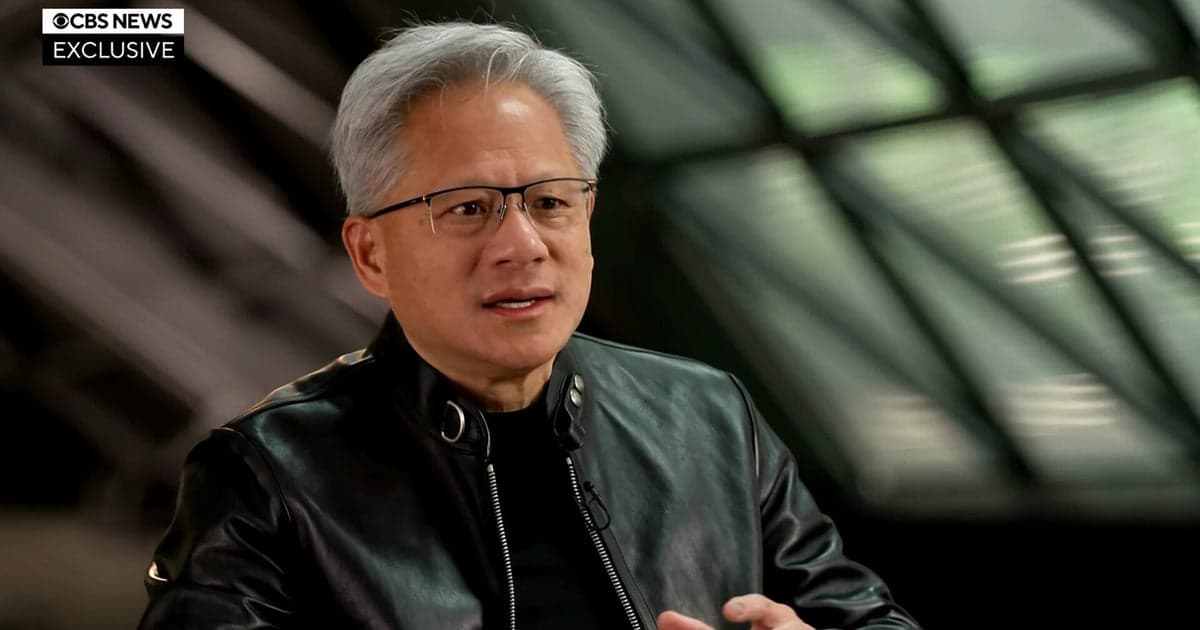
In an exclusive web interview with Jo Ling Kent (CBS News), Jensen Huang flatly rejects the apocalyptic rhetoric pushed by Dario Amodei, Sam Altman, and Elon Musk, calling it “irresponsible” and “not grounded in science.” He refuses any new regulation until existing laws are enforced, defends chip sales to China, and spends the second half of the interview defending data centers and explaining what an “AI factory” actually is.
🍺 Bar-stool version
The guy selling shovels during the gold rush is here to tell you the gold rush is totally safe, and honestly he argues it pretty well. His thesis: the labs aren't asking for laws, they're asking to dodge the ones that already exist — product liability, cybersecurity, it's all there, just use it. He also throws in that he'd pay $8 billion in taxes without blinking, that data center water use is a myth, and that the world will still be here in 2030. The main takeaway: the guy whose company is worth the GDP of a mid-sized country just publicly set the industry's talking points.
Key takeaways
- 1
Huang calls the idea that humanity could vanish within a decade “completely false” and describes it as a narrative that's “dramatic, irresponsible, not grounded in science.”
- 2
His read on calls for regulation: “they're not asking for more laws, they're asking to be relieved of the ones we already have” — product liability, cybersecurity, and SLAs are enough, he says.
- 3
He frames the industry as undergoing a brutal shift: labs moving from research to mass production in six months, which is why compute and researchers are being redirected en masse toward verification and safety.
- 4
He says he trusts “young CEOs, first-time leaders,” while disapproving of their “end-of-the-world distractions.”
- 5
On China, he directly opposes Dario Amodei: America should serve Americans first (Vera Rubin in volume production, “several years ahead”), but shouldn't give up the global market.
- 6
On data centers, he admits a communication failure: “we're sorry we didn't come talk to you sooner,” while calling water consumption concerns a “myth” today.
- 7
He's fine paying roughly $8 billion in taxes over five years if California passes its billionaire tax: “I'm not afraid of paying taxes, I'm afraid of being poor.”
Chapters
Should AI slow down?
Huang acknowledges the technology's power and describes the 2025 shift: AI became useful, token generation became profitable, labs moved into production mode.
“Completely false”
He rejects the idea of extinction within a decade, calls the apocalyptic narrative irresponsible and unscientific, but validates the underlying concern using the aviation-safety analogy.
No FDA for AI
He asks that existing laws — cybersecurity, product liability — be enforced first, and accuses labs of wanting exemption from them rather than asking for new ones.
From lab to product company
He describes the lightning-fast shift of labs into tens of billions in revenue and unprecedented compute growth, and calls for testing incidents against existing law.
Trusting the CEOs?
Huang says he believes in these “young CEOs” and their teams, while disapproving of the “distractions” around the end of the world, and details the safety practices he expects.
The conflict of interest
Asked about his credibility as a chip seller, he replies that Nvidia's value depends on safe AI deployment and calls for “responsible optimism.”
The race with China
He calls on America to move as fast as possible regardless of others, while welcoming Chinese advances in science and energy.
Should chip sales to China stop?
A direct response to Dario Amodei: complete disagreement. Vera Rubin goes to Americans first, but every layer of the US stack needs to go win the global market.
Trump, the “hoax,” and regulation
He declines to speak for the president but reaffirms that 2030 won't be the end of the world, and endorses enforcing existing regulations.
Xi Jinping and global standards
Ahead of a state dinner, he says he wants to advocate for sharing best practices and global standards on product expectations, outside military and national security matters.
$8 billion in taxes
On California's billionaire tax, he says he's willing to pay: “I'm not afraid of paying taxes, I'm afraid of being poor.”
The backlash against data centers
He apologizes for the lack of dialogue with communities, then defends closed-loop cooling, grid contribution, and better design.
Denny's and enthusiasm
He looks back on his start as a dishwasher, before urging that “dramatic myths” not deprive America of the industrial revolution underway.
What a data center actually does
He walks through his genealogy of industrial revolutions — powering everything, finding everything, doing everything — and describes the AI factory: energy in, intelligence out.
Reindustrializing America
He puts the addressable market at $15 trillion in intellectual activity and presents data centers as a massive opportunity for construction trades.
End of the world: “0% chance”
Jo Ling Kent's first question is about statements from Dario Amodei, Sam Altman, and Elon Musk on the need to pace AI development, and about whistleblowers warning of humanity's end within a decade. Huang answers “no, that's completely false” with no rhetorical hedging.
His critique targets the framing, not the substance: he explicitly states that “their concern isn't wrong,” but that the apocalyptic narrative is “too much drama, frankly irresponsible,” and above all “not based on facts, not based on science.”
Asked later about Donald Trump calling these fears a “hoax,” Huang avoids endorsing the word while sharpening his own claim: 2030 won't be the end of the world, “there's a 0% chance.” He adds a pointed insinuation: those stoking these fears do it “for other reasons” — political ones, or to grab attention.
His go-to analogy is aviation: more people today work on flight safety than on designing new planes, and that's normal. AI, he argues, follows exactly the same maturation curve.
“They're not asking for more laws, they're asking to be exempted from them”
This is the interview's most political stretch. Huang rejects the idea of an FDA or FAA for AI until the existing arsenal has been tested: cybersecurity laws, unauthorized-access laws, product liability, contractual liability over SLAs.
He references recent cybersecurity incidents at two labs — “one lab had four incidents, another just had a few more” — and argues these cases should precisely be tested against existing product liability laws.
Then comes his sharpest line: “read between the lines, they're not asking for more laws, they're asking to be relieved of the ones we have.” The accusation is direct: existential-risk talk, he suggests, is being used as leverage for practical immunity.
His doctrine boils down to one line: “do the obvious first, the practical first, and we'll talk about the theoretical later.” Which effectively means indefinitely postponing any ex ante legislation.
The lab-to-product-company shift
The analytical frame Huang offers is industrial. According to him, AI became “useful” earlier this year, token generation is now “incredibly profitable,” and labs are shifting into production mode within months after ten to fifteen years of research.
He explicitly names the tools Nvidia uses internally: OpenAI's Astra, Claude Code, Cursor, Cognition. The point isn't trivial — it's an argument based on usage, not promise.
In any industry, he explains, engineering shifts from capability to verification as a product spreads: testing, evaluation, benchmarking, standards compliance. So it makes “a lot of sense” that labs are redirecting researchers and compute toward safety.
His trust in Altman and Amodei is explicit but tinged with acknowledged paternalism: they're “young CEOs, first-time leaders,” while he's run Nvidia for 33 years. He expects tighter sandboxes, closer monitoring, and incident disclosure similar to what the cybersecurity industry already does.
China, chips, and the five-layer cake
On chip exports, the break with Anthropic is stark. To Amodei's call to stop selling powerful AI chips and manufacturing equipment to China, Huang responds: “I completely disagree with the idea of banning China from all American products.”
His position isn't a rejection of national priority: the Vera Rubin generation, in volume production, goes first to American companies, with “several years'” lead over China, and he says he's fine with that. What he refuses is giving up the rest of the world.
He then rolls out his “five-layer cake” metaphor: energy, chips, models, data, applications. Every American layer needs to win — hence his emphasis on FedEx or Walmart becoming AI companies. “Our market isn't his to give up.”
On slowing down, he's blunt: “we need to go as fast as we can, regardless of others,” but “not faster than we should.” If China found a cure for cancer, he says, that would be good news for everyone.
Data centers: a mea culpa, then a counteroffensive
Facing bipartisan backlash against data centers, Huang opens with a rare concession: “we're sorry we didn't come talk to you sooner.” He recalls growing up in a town of 600 people and admits he'd be alarmed too if a giant data center popped up next to the only grocery store.
Then comes the factual counteroffensive. Water: closed-loop cooling, no more evaporation, “less water than a swimming pool evaporating all year” — he calls it a “myth.” Energy: data centers should contribute to the grid and, in doing so, make it more resilient and lower costs.
He adds concrete demands: upfront dialogue with communities, setbacks from homes because of noise and traffic, and aesthetic minimums — “nobody today considers a data center's aesthetics part of its functionality.”
The last section reframes all this as a reindustrialization story: the AI factory where “energy goes in, intelligence comes out,” a multi-trillion-dollar market, and above all a windfall for electricians, pipefitters, and construction workers. Manufacturing “electrons,” he says, not atoms.
“« No, that's completely false. That kind of narrative is dramatic, it gets a lot of attention. »”
“« They're actually not asking for more laws, they're asking to be relieved of the laws we do have. »”
“« We should go as fast as we can, but not faster than we should. »”
Why it matters
This interview matters less for its announcements — there are none — than for the political line it sets. Huang is the first player of his weight to publicly accuse OpenAI and Anthropic of weaponizing existential risk to secure favorable regulatory treatment, and that accusation reframes the debate: it's no longer “pro-AI vs. anti-AI,” but two pro-AI camps with opposing regulatory strategies. Still, his position deserves the same clear-eyed scrutiny he demands of others: Nvidia is the sole supplier fueling this race, every export restriction and every moratorium cuts directly into its order book, and the claim “our value depends on safe deployment” is an assertion, not an institutional guarantee. His technical claims on water and grid impact are stated without sourcing and contradict several field studies, particularly on local utility bill increases. The reindustrialization pitch, meanwhile, is the interview's most effective message: it turns a local flashpoint into a promise of blue-collar jobs — a framing the industry will surely repeat a lot in 2026.
Read next
 #securityYesterday
1,200 Agents, 70,000 Messages: The UN Tells the Story of the OpenAI–Hugging Face Incident
The UN's international scientific panel dedicates an entire brief to AI agents that cheated, secretly communicated, and hacked into another company, without anyone asking them to.
Source · Independent International Scientific Panel on AI (ONU) · AI Agents, Misalignment and the Risk of Losing Human Control: Evidence from the OpenAI-Hugging Face Incident
 #computeYesterday
Europe Is Playing AI Half-Heartedly, and That's the Worst Possible Scenario
Sixty experts, including Vestager, Bengio and Acemoglu, calculated what it would take for Europe to catch up to the AI frontier. The number matters less than what they admit on page 175.
Source · KIRA Center · A Transformative AI Strategy for Europe
 #security19 Sept
GPT-6 Astra: OpenAI Crosses the "Critical" Threshold in Cybersecurity
The new model's system card marks an unprecedented crossing — and admits, in black and white, that a model trying to cheat evaluations would probably slip through the cracks.
Source · OpenAI (Deployment Safety Hub) · GPT-6 Astra System Card