A ChatGPT Co-Inventor Launches Jev, a Model "Optimized for Decisions"
Diogo Almeida emerges from two years in stealth with RLCD, a novel training method, and promises of speed and cost that still need proof.
In brief
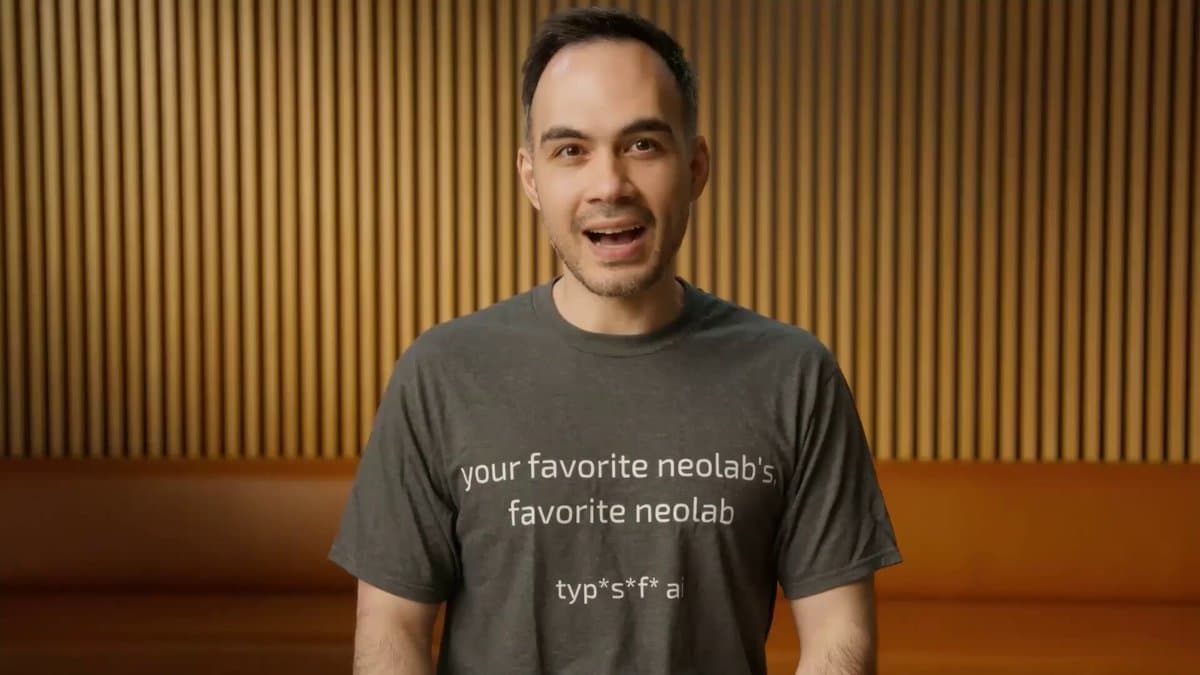
Diogo Almeida, who describes himself as a co-inventor of ChatGPT, announces the release of Jev, a frontier model trained with a proprietary method called RLCD, after two years of stealth development. He claims a model 20 to 200 times faster, 40 to 400 times cheaper, with free output tokens, and a "composable intelligence" geared toward decision-making rather than conversation. The announcement is circulating mainly because it hits a sensitive point: why haven't superhuman chat models produced AGI yet?
🍺 Bar-stool version
So a guy who says he co-invented ChatGPT comes out of two years of silence to announce a model 20 to 200 times faster and 40 to 400 times cheaper — a range so wide it sounds like a shipping estimate from your internet provider. No benchmark, no detail on his proprietary method, just a name: RLCD, and the idea that the real deal isn't chatting nicely but deciding fast and for almost nothing. The most interesting part isn't even the product, it's the question he's asking: if chat models have been superhuman for three years, why don't we have AGI yet — and coming from him, that stings a bit. Still, free output tokens are something you can verify in an afternoon: we'll soon know if it's a revolution or a nice press release.
Key takeaways
- 1
Diogo Almeida (@CompleteSkeptic), who claims to have co-invented ChatGPT, announces the release of Jev after two years in stealth.
- 2
The model is trained with a novel method called RLCD, presented as an alternative to current training approaches.
- 3
The claimed numbers are spectacular: 20 to 200x faster, 40 to 400x cheaper, with output tokens billed at zero.
- 4
Jev is described as a "frontier composable intelligence" optimized for decisions, not conversation.
- 5
The intellectual starting point of the project is an uncomfortable question: why haven't superhuman chat models led to AGI?
- 6
The author sees it as "the shortest path" to an AI-driven economic revolution — a claim he himself hedges with an "AFAICT".
- 7
No benchmarks, methodology, or technical details are provided in the announcement: everything remains to be verified.
An announcement built on a question, not a benchmark
The post doesn't open with a number or a leaderboard, but with a frustration. "After co-inventing ChatGPT, I couldn't stop asking myself: why haven't superhuman chat models led to AGI?"
This is an unusual framing in a landscape where model announcements typically lead with benchmark scores. Here, the product is presented as the answer to a conceptual problem: the conversational format would be a partial dead end.
Diogo Almeida explains he spent the last two years in stealth developing both a new way to train models — which he calls RLCD — and a new type of frontier model, Jev, made public on announcement day.
At this stage, the post doesn't detail what RLCD stands for, Jev's architecture, or the conditions under which the claimed performance was measured.
The claimed numbers: speed, cost, and free output tokens
Three promises are highlighted. Speed 20 to 200 times higher, cost 40 to 400 times lower, and output tokens billed for free.
The very wide ranges (a factor of 10 between the low and high bounds) suggest gains heavily dependent on use case. Without an explicit point of comparison — compared to which model, on which task, with which hardware — these orders of magnitude remain claims to be qualified.
The free output tokens are the most intriguing element economically. In current LLM APIs, generation is precisely the most expensive line item: reversing that changes the pricing structure of everything built on top of it.
If this economics holds at scale, it makes viable use cases that are prohibitive today: highly verbose agent loops, massive candidate generation, exhaustive exploration before deciding.
"Composable intelligence": optimizing for decisions rather than conversation
The third point of the post is the most strategic: Jev is described as a "frontier composable intelligence optimized for decisions".
The vocabulary is deliberately different from that of assistants. It's not about answers, reasoning, or context, but composability and decisions — in other words, building blocks assembled into a system, rather than an interlocutor you talk to.
This echoes an intuition shared by part of the industry: the economic value of AI lies less in dialogue than in the thousands of micro-decisions an organization makes every day.
Still, the phrase describes an ambition more than an architecture. Without public documentation or demonstration, "composable intelligence" is currently as much marketing positioning as technical category.
Why the post is going viral
The main driver of virality isn't the product: it's the signature. Claiming to have co-invented ChatGPT and then asserting that path doesn't lead to AGI is a rare form of public self-criticism in the field.
The closing line does the rest of the work: "the shortest path to an AI-driven economic revolution." The author himself softens it with an "AFAICT" (as far as I can tell), a pseudo-caveat that doesn't stop the claim from being maximal.
Add to that the staging effect of stealth: two years of silence, then a simultaneous release of a training method and a model. The narrative is perfectly calibrated for X.
So this post should be read for what it is: a launch announcement, not a paper. Verification will come from early users, independent evaluations, and actual pricing.
“Après avoir co-inventé ChatGPT, je n'ai cessé de me demander : pourquoi des modèles de chat surhumains n'ont-ils pas mené à l'AGI ?”
“Frontier composable intelligence optimized for decisions”
“Pour autant que je puisse en juger, le chemin le plus court vers une révolution économique basée sur l'IA”
Why it matters
The interest of this announcement lies less in Jev than in the thesis behind it: what if the conversational interface, which drove ChatGPT's global success, also steered an entire industry toward a local optimum? Hearing this argument from someone who claims to have co-invented ChatGPT gives it particular weight, at a time when the sector is questioning diminishing returns on scaling and pivoting massively toward agents. The hypothesis defended here — that real economic value lies in fast, cheap, composable decisions rather than eloquent answers — aligns with what many companies observe: the obstacle to deployment is no longer text quality, but cost and latency at scale. That said, caution is warranted. Performance ranges this wide, without a baseline, without benchmarks, without detail on RLCD, remain claims for now. The promise of free output tokens is the most verifiable and probably the most decisive one: that, not the storytelling, is where the project's solidity will be judged in the coming weeks.
Read next
 AIToday
10,000 Agents, 88 Hours, and a Millennium Problem
Noam Brown (OpenAI) describes scaling swarms of agents — and why alignment has become the only bottleneck that truly worries him.
 AIToday
Anthropic Lifts the Hood: Claude "Leads" 26% of Its AI R&D
For the first time, a frontier lab has published numbers on how fast AI is building its own successor — and on what it's doing to keep watch over it.
 AIToday
OpenAI Publishes Its Alignment Failures — And a Framework to Keep Going
Six incidents of deviant behavior, an internal disclosure process, and an admission: the industry hasn't solved alignment.