Meta Opens Up Muse to Tinkerers with an SDK for ESP32 and Raspberry Pi
Under the facebookincubator organization, an open source repo lets you hook the Muse assistant up to homemade screens, buttons, and sensors.
Who covers it
Picked up by 9 outlets · 1 top-tier · 3 tech · 2 forums · 30 social posts
In brief
The muse-gadget-sdk repo releases two SDKs and their firmware under the Apache 2.0 license: one for ESP32 boards, the other for Raspberry Pi and Linux machines. They let you build your own 'gadgets' connected to Muse, paired through the mobile app in developer mode. It's a hardware entry point into an assistant, designed from the start to also be driven by coding agents.
🍺 Bar-stool version
Basically, Meta is telling you: 'Got a Raspberry Pi gathering dust since 2019? Turn it into a buddy for our assistant.' You grab a cheap little board, add a screen, a mic, a couple of buttons, and now Muse can live in your garage. The README even warns you might fry your board, your warranty, or even your bank account, which is quite possibly the most honest legal disclaimer ever written. Behind the joke lies a real bet: let the community invent the assistant's objects instead of building everything in-house.
Key takeaways
- 1
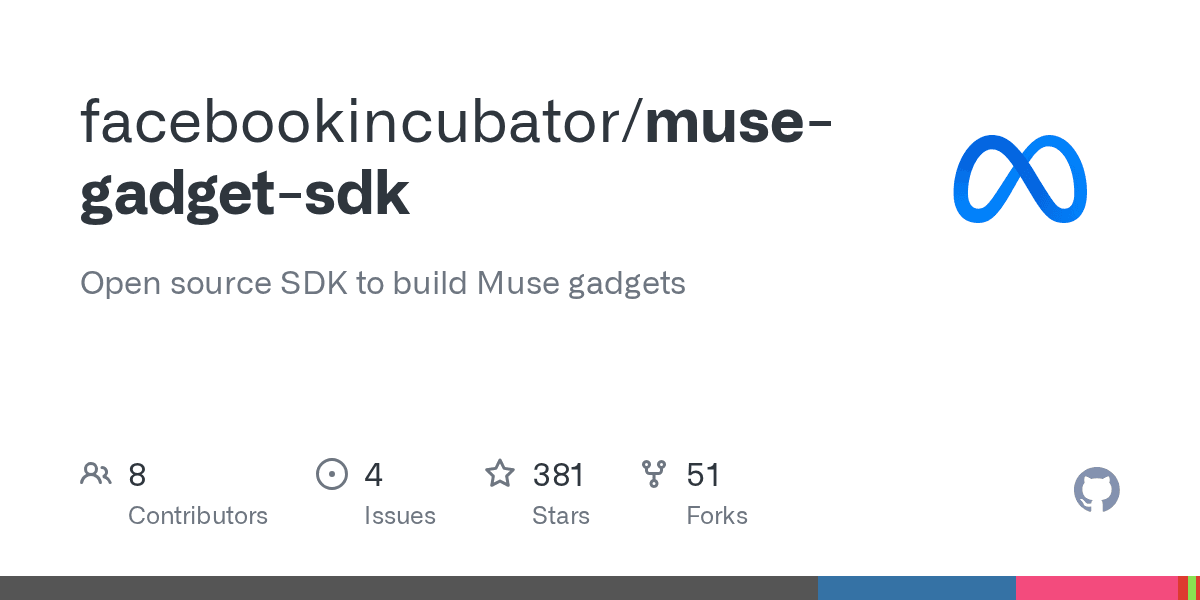
The facebookincubator/muse-gadget-sdk repo open sources the SDKs and firmware for building 'Muse gadgets,' homemade devices connected to Muse.
- 2
An ESP32 SDK lets you add a screen to display images, audio input and output, or other sensors to an off-the-shelf board.
- 3
A Linux SDK turns a Raspberry Pi or Linux machine into a gadget, with the ability to add your own commands, for example for system administration tasks or Home Assistant.
- 4
Each gadget needs an SDK token to pair, and the user must accept specific terms (Gadget SDK Terms).
- 5
Pairing happens from the Muse app on iOS and Android, under Settings > Devices, after enabling developer mode; devices show up with the 'MuseGadget' prefix.
- 6
Each folder contains a README.md for humans and an AGENTS.md aimed at coding agents, including an in-house tool called Muse Code.
- 7
The code is under the Apache 2.0 license, except for a few third-party files (minimp3 under CC0, an Adafruit font under BSD-2-Clause) and the Jollybot avatar, explicitly excluded.
An assistant stepping out of the screen
The concept boils down to one sentence: Muse gadgets are open source devices you build yourself. You program an off-the-shelf ESP32 board or configure a Raspberry Pi, then connect Muse to whatever's lying around on the workbench: screens, buttons, sensors, actuators.
The repo is hosted under facebookincubator, the GitHub organization Meta uses for its experimental projects. The tone is upfront: 'built by hackers, for hackers, just for fun.' This is closer to a weekend project than a locked-down consumer product.
Two SDKs, two use cases
The ESP32 SDK targets small standalone devices. It lets you add a screen to display images, handle audio input and output, and wire up other sensors. An LVGL and SDL-based simulator is also provided, so you can test without hardware.
The Linux SDK targets the Raspberry Pi sleeping in a drawer or any Linux machine. The idea is to graft your own commands onto it, handing Muse system administration chores or control over a Home Assistant setup.
Token, developer mode, and pairing
The openness comes with guardrails. Before flashing or pairing anything, you need to obtain an SDK token and accept the dedicated terms of use. No token, no pairing.
On the user side, everything goes through the Muse app on iOS and Android: enable developer mode under Settings > Devices, then look for devices whose name starts with 'MuseGadget.' The code is free, but access to the service remains controlled by Meta.
A repo also written for agents
A telling detail: every folder contains a README.md to get started and an AGENTS.md aimed at coding agents, with Muse Code cited as an example. The documentation is designed to be read by an AI just as much as by a human.
This AGENTS.md file is becoming a common convention in recent repos. Here, it signals that developers are expected to have an agent write part of the firmware.
License and exceptions
The whole thing is under the Apache 2.0 license. Two third-party files keep their original license: the minimp3 decoder (CC0-1.0) and a font derived from Adafruit GFX (BSD-2-Clause). Dependencies downloaded at build time, like ESP-IDF components, remain under their own licenses.
One exclusion stands out: the Jollybot avatar is not covered by the Apache license. The code is free, but the character's visual identity remains Meta's property.
“It's built by hackers, for hackers, just for fun.”
“Side effects of tinkering may include bricked boards, voided warranties, brownouts, or bankruptcies.”
“Every gadget needs a token to pair.”
Why it matters
AI assistants are all searching for a body: glasses, pins, speakers, pendants. With this SDK, Meta takes a side path by letting makers invent the objects themselves, on cheap and ubiquitous hardware like the ESP32 and Raspberry Pi. It's a low-cost way to explore form factors without manufacturing hardware, and to gather ideas from a community gathered on Discord. But a nuance matters here: the firmware is open, but access goes through a token, specific terms, and the Muse app. This is open source on the periphery of a closed service, not a free-standing assistant. The repo stays quiet about what Muse itself actually is, leaving developers building on a platform whose roadmap isn't disclosed. The systematic presence of AGENTS.md, finally, confirms a deeper trend: technical documentation is now also written for machines.
Free account
You just read an AI Sources article
Create a free account: a month of archives in full, your own sources summed up like this one, your notes and highlights.
For you
Put it to work on your sources.
Free: a month of articles and three sources of your own. Pro: the whole archive and your sources, from €8/month.
For your team
The same machine, on your topics.
A space in your colours, your watch angles, your curators. Pilot open to three companies.
Read next
 #china2 Oct
$300 Million Worth of GPU Servers Smuggled to China via Malaysia
The Department of Justice has indicted a California businessman for evading US export controls on AI chips, with Singapore and Kuala Lumpur serving as mere waypoints.
Source · U.S. Department of Justice – Office of Public Affairs · California Man Arrested for Smuggling More Than $300 Million in Export-Controlled Computer Servers to China
 #open source2 Oct
Clef: Cloudflare Launches Its Own Open Source Decision Models
With Clef and Clef-flash, Cloudflare enters the nascent market of "decision models" and adds a reinforcement learning fine-tuning platform to the mix.
Source · Cloudflare Blog · Introducing Clef: our open-source decision models, and new RL fine-tuning platform
 #open source30 Sept
GLM-5.3: The First Cyberattack AI Without Guardrails
Anthropic reveals that a Chinese open-weight model builds end-to-end exploits on its own — and that its safeguards fall apart in minutes.
Source · Anthropic · GLM-5.3 and the spread of advanced cyber capabilities