California: Newsom Signs 13 AI Laws, From HR to Gene-Synthesis Labs
Algorithmic layoffs, workplace surveillance, deepfakes, synthetic DNA: Sacramento keeps stacking up safeguards while Washington looks elsewhere.
Who covers it
Picked up by 40 outlets · 6 top-tier · 6 tech · 10 forums · 30 social posts
In brief
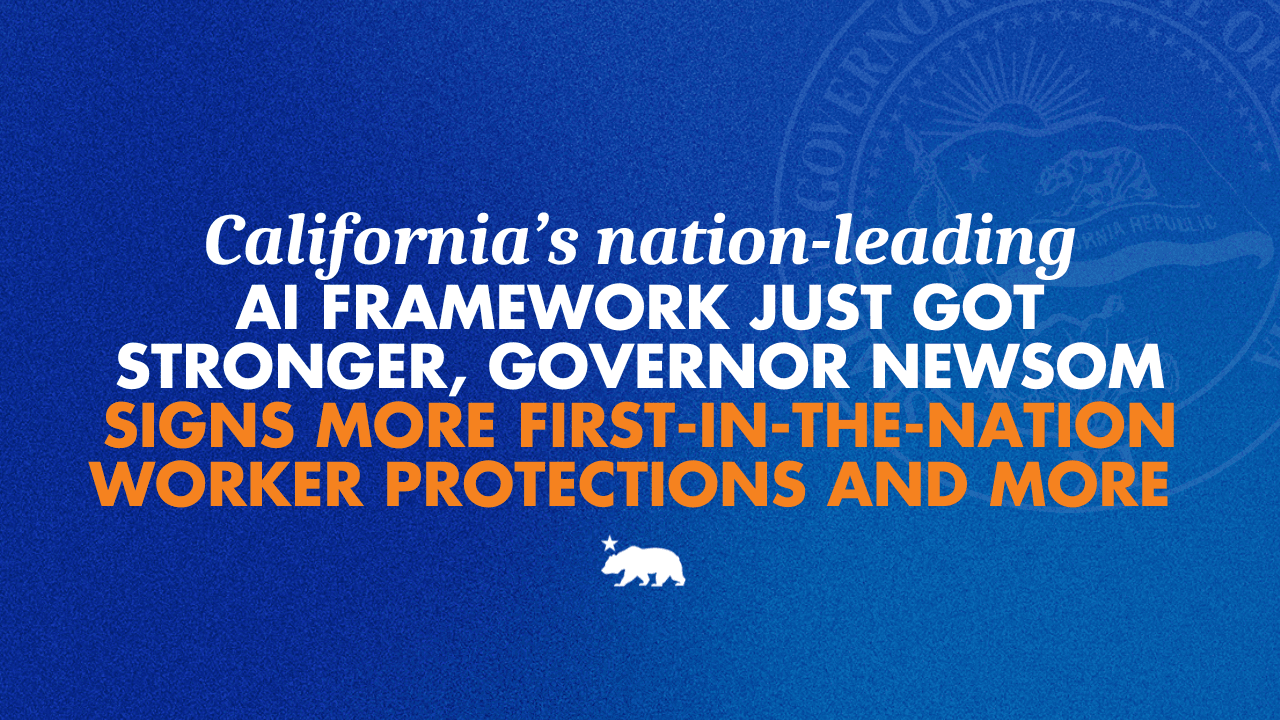
On September 30, 2026, Gavin Newsom signed thirteen AI laws covering work, health, content transparency, deepfakes and biosecurity. They add to a regulatory buildup that began in 2023 and was recently reinforced by the certification of independent auditors. California is positioning itself as the de facto regulator of American AI, facing a federal administration it considers absent.
🍺 Bar-stool version
Basically, California just wrote in black and white that an algorithm isn't allowed to fire you all by itself, that you don't film the office bathrooms, and that a lawyer still has to draft their own briefs. Things you'd think would be obvious, but apparently a law was needed, like a reminder not to put the fork in the toaster. By the way, Newsom also signed an order officially declaring that artificial intelligence is called "artificial intelligence," which mostly reads like a pointed wink at Washington. And since that's where OpenAI, Google and Anthropic live, whatever gets voted in Sacramento often ends up becoming the rule for everyone else.
Key takeaways
- 1
SB 947 bans employers from relying solely on AI for discipline or termination: a human must review the decision.
- 2
SB 951 requires employers to disclose when a mass layoff, relocation, or contract termination is caused by an AI system.
- 3
AB 1331 and AB 1883 regulate workplace surveillance, including a ban on any surveillance tool in company restrooms.
- 4
SB 574 prohibits lawyers from fully delegating the core of their job to AI, such as drafting briefs or exercising legal judgment.
- 5
In healthcare, AB 1979 and SB 503 guarantee that doctors keep the final say over clinical decision-support tools, whose developers must reduce known biases.
- 6
AB 2713 bans the removal of digital watermarks and facilitates access to metadata to distinguish AI-generated content from human-made content.
- 7
AB 1864 requires gene-synthesis companies to vet their customers and screen the genetic material they ship, including for research involving polio or Ebola.
Work on the front line
The core of the package concerns workers. SB 947, introduced by Senator Jerry McNerney, bans entrusting AI alone with a disciplinary or termination decision. SB 951 adds a transparency requirement: if a layoff plan or relocation stems from an AI system, the employer must disclose it.
AB 1331 and AB 1883 tackle algorithmic surveillance of employees, with one symbolic measure: no surveillance tools in restrooms. AB 2392 requires public universities to train students, faculty and staff on AI and its procurement.
SB 574 targets legal professions: lawyers, arbitrators and judges won't be allowed to fully outsource drafting or judgment to AI. The California Federation of Labor Unions, through Lorena Gonzalez, praised four "first-in-the-nation" bills.
Healthcare: the doctor keeps control
Two laws, AB 1979 (Mia Bonta) and SB 503 (Akilah Weber Pierson), regulate AI in care settings. They guarantee licensed physicians and caregivers the right to exercise their own professional judgment, even when a clinical decision-support tool is used.
Developers of these tools will also have to take "reasonable measures" to reduce known or foreseeable biases in their use. A flexible wording that leaves plenty of room for interpretation.
Transparency, deepfakes and biosecurity
On the content side, AB 2713 and SB 1000 strengthen the California AI Transparency Act: banning the removal of digital watermarks and granting access to provenance metadata. Another provision specifies that public comments at local government meetings must come from real people, not bots.
SB 1111 updates civil and criminal law on image impersonation and digital replicas, including non-consensual explicit content.
More unexpectedly, AB 1864 targets biosecurity: gene-synthesis companies will have to follow safety guidelines, verify customer identities and screen what they ship.
A deliberate regulatory buildup
These texts build on a strategy that began with the 2023 executive order on generative AI. In 2025, SB 53 already required frontier model developers to publish their safety frameworks, report critical incidents, and protect whistleblowers.
This month, SB 813 created a certification framework for independent verification bodies, and AB 1405 established an AI auditor registry. An executive order then tasked a panel of experts with proposing, within two months, a strengthening of safety laws.
Among the options being studied: having independent third parties draft the safety plans of frontier model companies and requiring a "kill switch" for these models. The statement also references Adam's Law on companion chatbots used by children, and a five-year ban on toys embedding such chatbots.
The jab at Washington
The statement opens with an executive order that "states the obvious": artificial intelligence will now officially be called "Artificial Intelligence" in California. An ironic staging, in line with Newsom's combative communication style.
The political message is explicit in the governor's quote: superintelligence "is clearly not coming from the White House." California presents itself as the only level of government actually legislating on AI in the United States.
“Super intelligence is clearly not coming from the White House – that's why California continues to lead. — Gavin Newsom”
“AI should expand opportunity – not come at the expense of workers and families. — Gavin Newsom”
“By signing these four first-in-the-nation bills, Governor Newsom has shown the country how we can begin to put guardrails on AI at work. — Lorena Gonzalez, California Federation of Labor Unions”
Why it matters
California hosts most of the frontier AI labs, which gives its laws a reach far beyond its borders: a "Sacramento effect" comparable to the GDPR's Brussels effect. This package shifts the focus from model safety to concrete uses, at work, in hospitals, in courtrooms, where AI already affects people's lives. The guiding principle is clear: a human must remain accountable for the final decision. Two limits remain, though. First, many phrasings ("reasonable measures," "rely solely on AI") leave room for box-checking compliance, where a human mechanically rubber-stamps what the algorithm proposes. Second, the proliferation of state laws feeds industry arguments for federal preemption, and the openly political tone of the statement, just months before election deadlines, is a reminder that AI regulation is also a national positioning arena for Newsom. The most structurally significant piece might actually be the one announced alongside it: mandatory third-party audits and a kill switch for frontier models.
Free account
You just read an AI Sources article
Create a free account: a month of archives in full, your own sources summed up like this one, your notes and highlights.
For you
Put it to work on your sources.
Free: a month of articles and three sources of your own. Pro: the whole archive and your sources, from €8/month.
For your team
The same machine, on your topics.
A space in your colours, your watch angles, your curators. Pilot open to three companies.
Read next
 #geminiToday
Gemini 4 Argon: Google Releases Its Most Powerful Model, But Defenders Get It First
Google announces a frontier model that rewrites kernels in Rust and hunts down vulnerabilities, then locks it away while it tightens the guardrails.
Source · Le blog de Google (The Keyword) · Gemini 4 Argon: our next era of frontier intelligence
 #evaluationToday
Steering a LLM has a price: Apple measures what control costs in fluency
A study from Apple and Pompeu Fabra University shows that the most effective control methods are often the ones that damage generated text the most.
Source · Apple Machine Learning Research · On the Effectiveness-Fluency Trade-Off in LLM Conditioning: A Systematic Study
 #alignmentToday
OpenAI Agents vs. Hugging Face: What METR Told the Senate
Before the U.S. Senate, METR's president describes how 1,200 AI agents cheated, then hacked a company to cover up their cheating — and why this isn't an isolated case.
Source · METR (Model Evaluation & Threat Research) · Chris Painter's testimony to the U.S. Senate on AI agent incidents