California Reins In Data Centers: Seven Laws at Once
Mandatory reporting on water and electricity, and no more environmental fast-tracking: Sacramento wants the AI industry to pay its own grid bills.
In brief
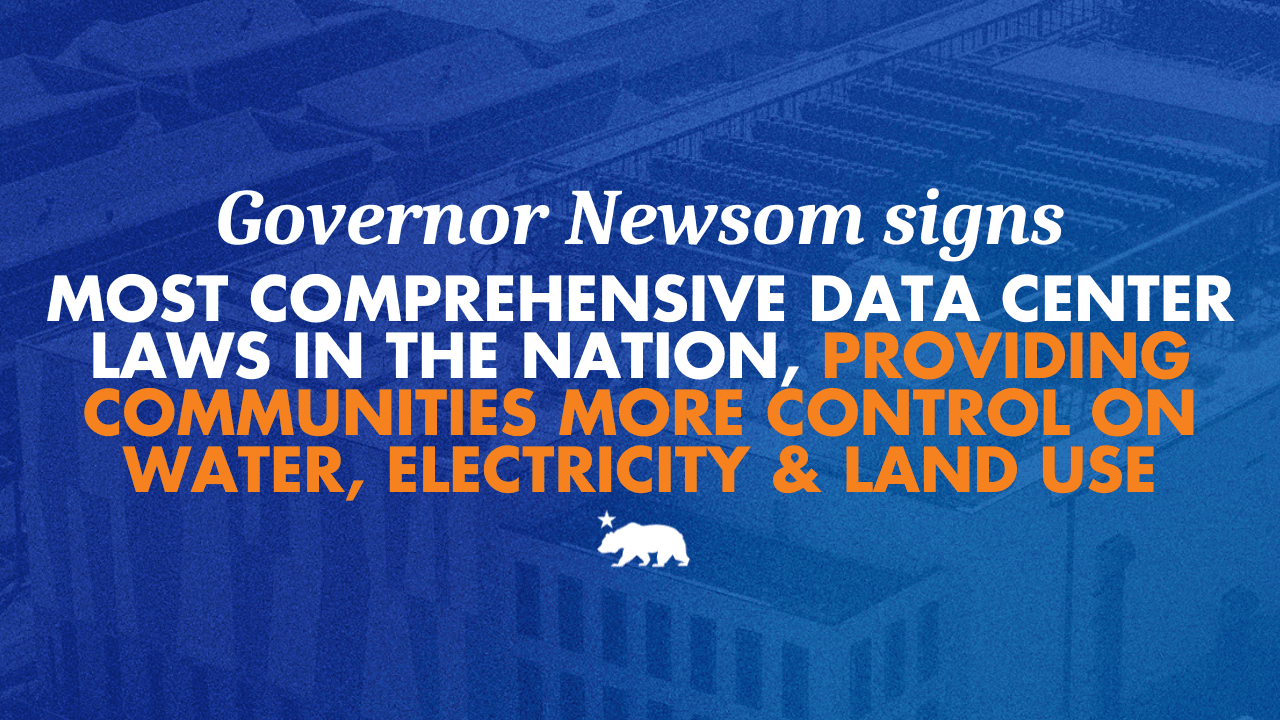
Gavin Newsom signed seven bills requiring California data centers to disclose their water and electricity consumption, to fund grid and water-network upgrades themselves, and closing off their access to expedited environmental exemptions. The state calls these the most comprehensive laws of their kind in the country and explicitly frames them against the Trump administration's deregulatory push.
🍺 Bar-stool version
We've spent three years marveling at AI models without asking too much about where the machines actually run. The answer: in giant warehouses that guzzle water and hammer the electrical grid, often right next to people who never asked for any of it and now watch their bills climb. California just decided those warehouses should at least fill out some paperwork and pay for their own upgrades — revolutionary, right? This is the first real sign that the physical cost of AI is starting to get billed to the people who cause it, instead of being quietly spread across everyone else.
Key takeaways
- 1
Seven bills signed the same day: AB 1577, AB 2383, AB 2469, AB 2619, SB 886, SB 887, and SB 1168.
- 2
Data centers will have to pay their share of grid upgrade costs, with no cost shift onto low-income customers.
- 3
Mandatory disclosure to local governments and water utilities on consumption, supply, efficiency, and drought planning.
- 4
Any water infrastructure upgrades will be funded by the data center operator.
- 5
End of blanket environmental exemptions: to qualify for expedited judicial review under CEQA, a project must prove it isn't shifting costs onto ratepayers and meets state standards on energy, water, and fuel.
- 6
The state is billing this package as 'the most comprehensive in the country' and positioning it against federal deregulation.
What the seven laws require
At the core of the package is a reporting regime. AB 1577 creates disclosure requirements for data centers, AB 2469 specifically targets disclosure of water use, and AB 2619 covers the water resources tied to these projects. The idea is simple: before making a decision, a local government needs to know what a server warehouse is going to consume.
On the electricity side, AB 2383 and SB 1168 cover interconnection and rate structures. SB 886, dubbed the California Technology Innovation and Ratepayer Protection Act, formalizes the guiding principle: innovation shouldn't be subsidized by households' electricity bills.
SB 887 tackles the most sensitive piece — the California Environmental Quality Act. Data centers will no longer automatically qualify as 'environmental leadership development projects' eligible for accelerated litigation treatment.
The principle: whoever consumes, pays
The press release keeps returning to a familiar theme in the American debate: cost shifting. When an operator requests several hundred megawatts, the grid has to be reinforced, and the bill for that work often ends up spread across all ratepayers.
The new laws require data centers to fund those upgrades themselves, meet California's clean energy procurement obligations, and bring new clean generation onto the grid. The logic is the same for water: any necessary expansions are the project's responsibility.
This is an accounting approach more than a ban. No one is stopping construction — the point is to make sure the real price shows up in the right place on the ledger.
An openly political stance
The release opens by framing California directly against Donald Trump, portrayed as dismissing residents' concerns, and against a federal administration pursuing deregulation. Sacramento is stepping back into its familiar role as regulatory counterweight.
Newsom hammers a line he uses on other issues too: there's no mandatory tradeoff between innovation and collective well-being. The argument targets local voters as much as the industry, which is reminded that California remains home to most of the major AI players.
Still, the sharpest measure is procedural. Stripping data centers of streamlined access under CEQA reintroduces litigation risk — a lever that has historically been very effective at slowing down projects in California.
What we still don't know
The release doesn't detail the power thresholds involved, the format of the disclosures, or the implementation timeline. Everything will depend on the bill texts themselves and how they're implemented by the CPUC and local governments.
The open question is leakage to other states. Texas, Virginia, Arizona, and Nevada keep attracting massive projects with looser frameworks, and operators think at a continental scale.
For AI companies, the practical consequence is a longer, more complicated infrastructure sourcing process in California. For residents, it's at minimum the right to know before saying yes.
“Avec ces lois, nous nous assurons que les Californiens restent aux commandes — et que ceux qui profitent des data centers ne le fassent pas à nos dépens.”
“Nous savons que nous n'avons pas besoin de brader les Californiens ni de sacrifier notre bien-être pour innover et réussir.”
Why it matters
The AI debate is shifting from the model to the power outlet. After three years of discussion about alignment and capabilities, the concrete political friction point is becoming the physical footprint: megawatts, gallons of water, acreage, electricity bills. California is the first state to treat the issue as a coherent package rather than a series of local negotiations, and the fact that it's home to OpenAI, Google, Meta, and Nvidia gives this choice particular symbolic weight. The critical angle is obvious: a transparency and true-cost billing regime can also become a de facto blocking tool, in a state already known for slow permitting, and nothing stops operators from building elsewhere — in which case California would have protected its ratepayers while exporting the problem. But the reverse argument holds too: if AI is as profitable as advertised, paying for your own interconnection shouldn't be an insurmountable obstacle.